Admiral of God
Columbus, Piety, and the Crossing of 1492
In early August 1492, three small ships left Palos de la Frontera. Their admiral was a Genoese wool-weaver's son who had spent years pressing his case before the courts of Portugal and Castile.
Each syllable is respelled for an English reader. The filled, raised block carries the stress. IPA follows for precision.
Taíno and Island Carib have no living native speakers. These readings are reconstructed from 15th–16th-century Spanish spellings.
He was sure of two things: that the ocean could be crossed, and that God meant him to cross it. The first conviction rested on bad arithmetic. The second rested on something he never thought needed proof.
It is often said that Columbus crossed without the instruments of a learned navigator, and in the sense that matters, that is true. He carried a quadrant, and on later voyages an astrolabe. But on the open Atlantic these tools failed him. Taking a star's altitude from a rolling deck was hard enough for experts, and Columbus was not one. When he tried to fix his latitude off the coast of Cuba, he got a figure that would have put him near Cape Cod. The celestial navigation of his age, the craft of the Portuguese pilots who measured the sun's height and consulted printed tables, was not what carried the Santa María , the Pinta , and the Niña west.
What carried them was dead reckoning, a humbler and more personal art. You know your heading from the compass. You turn the half-hour glass and estimate your speed by watching foam slide past the hull. From these you plot where you must be. It is navigation by judgment, memory, and nerve, and Columbus was among the finest dead-reckoning sailors who ever lived. His reckonings across open water were remarkably good. His instruments of the heavens were nearly useless. In that gap between what he could measure and what he had to trust, his faith did its work.
A ship at prayer
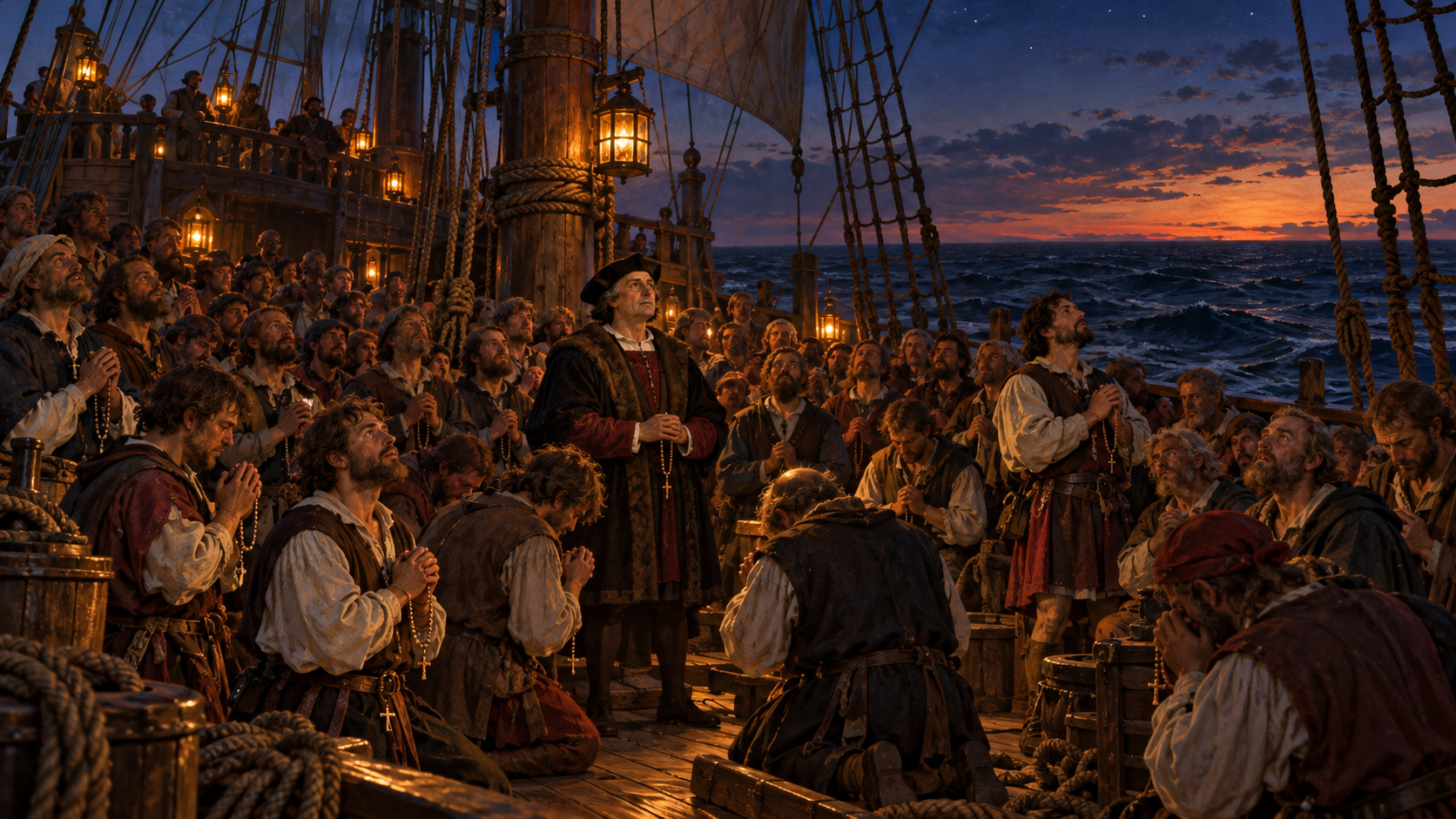
Life aboard ran on the rhythm of the Church. The ship's boys sang out prayers at the turning of the glass. Each evening the crew gathered to sing the Salve Regina, ninety men in the middle of an unknown sea asking the Queen of Heaven for mercy. These were not decorations on a commercial voyage. For the men aboard, the ocean was God's creation and held God's terrors, and the only reasonable response to it was prayer.
Columbus's piety went further than his crew's. He was a man of fierce, even apocalyptic, religion. He read the prophets and believed the world's end was coming. He believed the gold of the Indies would pay to free Jerusalem. In later years he compiled a Book of Prophecies to show that scripture had foretold his voyages. He took to signing his name Xpo Ferens , "Christ-bearer," reading his own first name, Christopher, as a calling. He believed, without irony, that he had been chosen.
He kept his reckoning as a seaman must, and he read the sea as a believer does.
The fact that God had chosen him for this voyage, shaped how he handled the crossing's critical moments. By late September the crew was frightened and close to mutiny. The trade winds blew steadily west, and they wondered whether any wind would ever carry them home. The compass needle drifted from true north in a way no one aboard could explain. Columbus kept two reckonings of distance, a true one for himself and a shorter one for the men, so they would not panic at how far they had come. (His "false" log turned out to be closer to the truth than the real one.) When the sea rose without wind, he wrote in his journal that it was a sign. He compared it to the waters that had risen for Moses when the Hebrews murmured against him in the wilderness.
To Columbus there was no contradiction between prudence and faith. He kept his reckoning as a seaman must, and he read the sea as a believer does.
Landfall
In the early hours of October 12, 1492, a sailor on the Pinta named Rodrigo de Triana saw a white cliff in the moonlight and cried out. But Columbus held that the first sight was his. At ten the night before, he had seen a light on the horizon, rising and falling like a small wax candle, and the Crown awarded him the prize.
When they came ashore that morning, the first act was not a survey or a trade. They planted the royal banners, knelt, and gave thanks. The island its people called Guanahaní, Columbus named San Salvador, "Holy Savior." The first name Europeans gave the New World was a name for Christ.
The Lucayan Taíno name for the island of first landfall, which Columbus renamed San Salvador on October 12, 1492. The final í carries the stress.
What faith did, and what it didn't
Columbus crossed the Atlantic on seamanship and faith. He knew the ocean's winds better than almost anyone alive, sailing south to the Canaries to catch the easterlies going out and coming home on the westerlies to the north, and his dead reckoning was excellent. But skill alone does not explain him. He was chosen by God, the Christ-bearer, and he signed himself Xpo Ferens to the end of his life. It was in the prophets, where he found his voyage foretold. He was the messenger of the new heaven and new earth promised in Isaiah and the Book of Revelation, sent to find them, and he said so plainly. In January 1492, refused once more, he rode away from Granada with his cause apparently lost. Then Luis de Santángel went to Isabella and urged her not to let the chance slip, telling her that this enterprise could bring great service to God and exaltation to His Church. The Queen sent a rider after Columbus, who caught him at the bridge of Pinos Puente and brought him back.
The islanders Columbus met were not one people with one fate. The Taíno lived in fear of the Caribs, raiders from the islands to the southeast who came in war canoes, killed the men, carried off the women, and ate their captives. The Taíno told Columbus this on the first voyage, and on the second, in 1493, the Spanish saw it on Guadeloupe. The fleet's physician, Diego Álvarez Chanca, wrote that they found human bones in the houses and freed Taíno women and boys held there. The boys had been castrated and were being fattened to be eaten. To the Taíno, the Spanish with their ships and weapons offered protection from a savage, man-eating enemy that had preyed on them for generations. The cacique Guacanagarí allied himself with Columbus. When the Santa María ran aground on Christmas Eve, his people worked through the night to save its cargo, and Columbus wrote of them with real admiration. One islander from Guanahaní was baptized with Columbus's own name, Diego Colón, with the Admiral as his godfather. He served as interpreter on later voyages and remained close to the family. In 1494, when captured caciques were brought before him under sentence of death, Columbus pardoned them after another cacique pleaded for their lives. Monsters do not pardon the condemned, stand godfather to an islander's baptism, or offer the work of their lives to the service of God.
Names of the islands
Often glossed "good" or "noble" — a word islanders used to set themselves apart from the Caribs.
Cacique of Marién in northwest Hispaniola, ally of Columbus on the first voyage.
Chief. Adopted into Spanish, and from Spanish into English.
"Mountainous land" — a Taíno name for Hispaniola, kept today in Haiti.
The name the Island Caribs use for themselves; their descendants live in Dominica today.
The Spanish rendering of the islanders’ name for the raiders of the southeast. English: KARR-ib.
Kalinago name for Guadeloupe, often given as "island of beautiful waters."
Columbus’s journal records the Taíno name for the feared raiders.
Linked to the Great Khan by Columbus; the name became a byword for man-eaters.
Displaced the older "anthropophagi" within a century.
In 1500, the Crown's investigator, Francisco de Bobadilla, sent Columbus home from Hispaniola in chains. On the voyage, the ship's captain, Andrés Martín, offered to strike them off. Columbus refused. The sovereigns had ordered them put on, he said, and only the sovereigns could order them taken off. He would accept no quiet kindness that left the injustice unspoken. He landed in Cádiz still in irons, and when Ferdinand and Isabella learned of it they ordered him freed at once, received him at Granada, and disowned the humiliation done in their name. He kept the chains, and his son Fernando wrote that he wanted them buried with him, as a witness to how he had been repaid. He spent his last years demanding the full restoration of the titles and rights the Crown had promised him in 1492, and he would not settle for less.
The chains Columbus kept were the last visible mark of a man who had done what no court and no pilot of his day thought could be done. Sailed west on dead reckoning and the conviction that the ocean was not a barrier God had closed, measuring distance by the half-hour glass and the slide of foam past the hull, holding a true reckoning for himself and a shorter one for the crew so that fear would not turn them back. When the sea rose without wind, the journal called it a sign, the same waters that had risen for Moses when the people murmured in the wilderness. The island named San Salvador became the first fixed point of Christendom in the Americas. From that point the Western world entered a new hemisphere, and the United States, the freest and most prosperous order that has yet appeared, stands on the far shore of the same ocean forced open by a Genoese sailor who refused to accept that the sea was closed. Without that crossing there is no America as the West has known it, and no West that reaches both sides of the Atlantic under the same law and letters. Towns across the United States still carry the name: Columbus, Ohio; Columbus, Georgia; Columbus, Mississippi; Columbia, South Carolina. Statues of the Admiral that once stood in their squares have been pulled down, spray-painted, or hauled away under the orders of men who call themselves the heirs of the same continent. The savages who committed themselves to such depravity would have been the same ones Columbus would have gladly saved—the same sort who once raided in war canoes, and the same sort who, given the chance, would have eaten the crews of the Santa María , the Pinta , and the Niña . The Admiral of God was owed the titles promised; history and God Himself answered by making the New World the foundation of the United States of America, the greatest power the world has ever seen.
Happy Columbus Day, and God Bless America!