The Six-Pack and the Cessna
Notes on a case pre-sold to the Supreme Court — and on the craftsmanship of making a hard question look like long division.
Ken Jouppi in his hangar, Fairbanks. The aircraft has not flown since 2012.
Abush pilot, for readers whose aviation experience is confined to complaining about legroom, is a person who flies small aircraft into places that have no business being flown into. The term refers to the bush — the roadless interior of Alaska, Canada, Australia, and other territories where the map runs out of ink — and not, as a certain kind of reader may briefly hope, to any botanical cargo.
A bush pilot should not be confused with a kush pilot, which is not a profession but a felony, and which involves a different relationship to both altitude and federal law. The bush pilot's cargo is duller and more essential: groceries, mail, diesel parts, schoolteachers, sled dogs, the occasional casket. In the villages of interior Alaska, where there are no roads and the rivers are frozen or flooding depending on the month, the bush pilot is not a romantic figure so much as a utility. He is the grocery truck, the ambulance, the postal service, and the moving van, consolidated into one aging airframe and one aging man.
Ken Jouppi was such a man for the better part of five decades. He is now in his eighties. On an April morning in 2012, he prepared to fly a passenger and her groceries the hundred and ten miles from Fairbanks to the village of Beaver, a settlement on the Yukon that had voted itself dry in 2004.
Packed among the passenger's groceries were three cases of beer — two of Budweiser, one of Bud Light — intended, in a detail no novelist would dare invent, as a gift for her husband, the village postmaster. State troopers searched the plane before takeoff. Jouppi said he did not know the beer was aboard; he does not, he says, search his passengers' luggage, any more than a taxi driver rifles through a fare's shopping bags.
The troopers said one six-pack was in plain view. A jury convicted him of a misdemeanor. He was sentenced to the statutory minimum: three days in jail and a fine of fifteen hundred dollars.
Then the state came for the airplane.
The aircraft in question is a 1969 Cessna U206D, valued at roughly ninety-five thousand dollars, which also happened to constitute the man's livelihood. Under Alaska law, a vehicle used to transport alcohol into a dry community is subject to forfeiture, and the state has pursued the plane with a persistence it does not always bring to, say, its backlog of untested evidence kits.
The pursuit has now lasted fourteen years — longer than the Second World War and the Apollo program combined — over a quantity of beer that a Green Bay tailgater would regard as an appetizer. This past April, the Alaska Supreme Court blessed the seizure, reasoning that the illegal importation of even a six-pack of beer causes grave societal harm in remote communities, and that the forfeiture of the airplane therefore does not offend the Constitution. Last week, the Supreme Court of the United States agreed to hear the case. Arguments are expected in the fall.
The Arithmetic
The arithmetic is not subtle, and it is worth doing slowly, because the entire case lives inside it. One needs a law degree only to explain how the situation persisted for fourteen years.
Bars to scale. Under Bajakajian (1998) proportionality is measured in significant part against the maximum fine the legislature authorized — the middle bar, not the top one.
Three cases — seventy-two cans — were on the plane. Six of them were in plain view, which is the quantity for which the pilot could be held culpable and, not incidentally, the quantity that fits in a headline.
Fairbanks to Washington
One hundred and ten miles, no road. Dry communities marked; the hatched interior has no surface access at all. Click the map to enlarge; scroll to zoom.
Beaver's prohibition was not imposed by Juneau. The village voted itself dry — an exercise of exactly the community self-governance libertarians elsewhere celebrate.
One Word, Two Outcomes
The Packaging
What makes the matter genuinely interesting is not the legal question, which is about as difficult as long division. It is the manner in which the question has been prepared for consumption.
The Institute for Justice did not merely litigate this case; it selected it, packaged it, and distributed it as one distributes a product. Every component has been chosen, or at minimum foregrounded, for maximum narrative efficiency. The facts are accurate. The framing is commercial.
And the framing does real work, because the underlying situation is considerably less tidy than the six-pack suggests. Alcohol has done catastrophic damage in rural Alaska; the state court's recitation of the harms is not rhetoric but epidemiology. Enforcing local-option laws across a territory the size of Western Europe, with no roads and a handful of troopers, is genuinely hard, and the forfeiture statute exists because the aircraft is, in a practical sense, the only chokepoint.
None of this justifies taking a ninety-five-thousand-dollar airplane. All of it complicates the story. And all of it has been compressed into a single memorable absurdity.
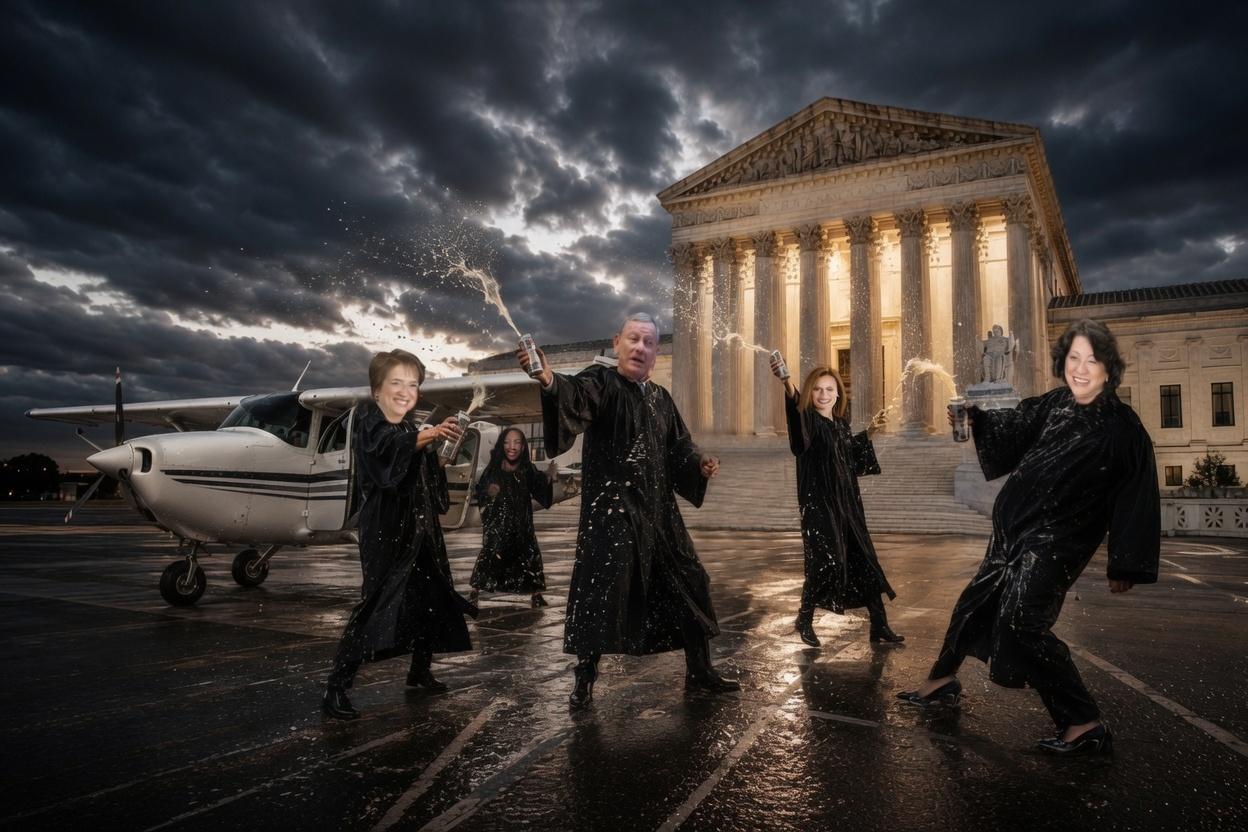
The lowered price of consensus. A nine-to-nothing reversal lets the justices demonstrate, for one news cycle, that they can still agree about something. Oil on canvas. Commissioned for The Docket Quarterly.
They took his plane over a six-pack. The sentence that made the sale before the argument began
Salesmen
Salesmen are often companionable people. They know how to present a clean surface, how to make the difficult appear simple, how to remove from the buyer's field of vision anything that might occasion a second thought. What they are less often is rigorous, and the distinction matters here, because the packaging that makes this case easy also makes it small.
The deep disagreements on the current Court — about the nature of property, about how far federal constitutional constraints should reach into state police power, about whether forfeiture regimes that fund the very agencies that operate them are punishment, taxation, or a racket — will remain entirely untouched by whatever opinion emerges. They have merely been placed offstage.
They will return the moment the defendant is a drug courier rather than a grandfather, the ratio is four-to-one rather than sixty-to-one, and the property is a Suburban with tinted windows rather than a Cessna with a story. The present case has been rendered safe for unanimity precisely because the marketing has drained it of every residual difficulty. That is not a triumph of legal reasoning. It is a triumph of sales.
There is a further irony, which is that the Court is a willing customer. An institution polling somewhere between Congress and the common cold has its own incentives to buy what the Institute is selling. Unanimous reversals in sympathetic cases are the judicial equivalent of a corporate charity drive: sincere, useful, and also a form of reputation management. Both sides of this transaction understand it perfectly. Neither will describe it.
What the Opinion Will and Will Not Do
The beer, for the record, never reached Beaver. The postmaster went without his gift. The airplane sat.
And fourteen years later, the whole cargo — the cans, the Cessna, the old man, and the Eighth Amendment — is finally being flown to Washington, by a pilot who knows exactly where he's landing.