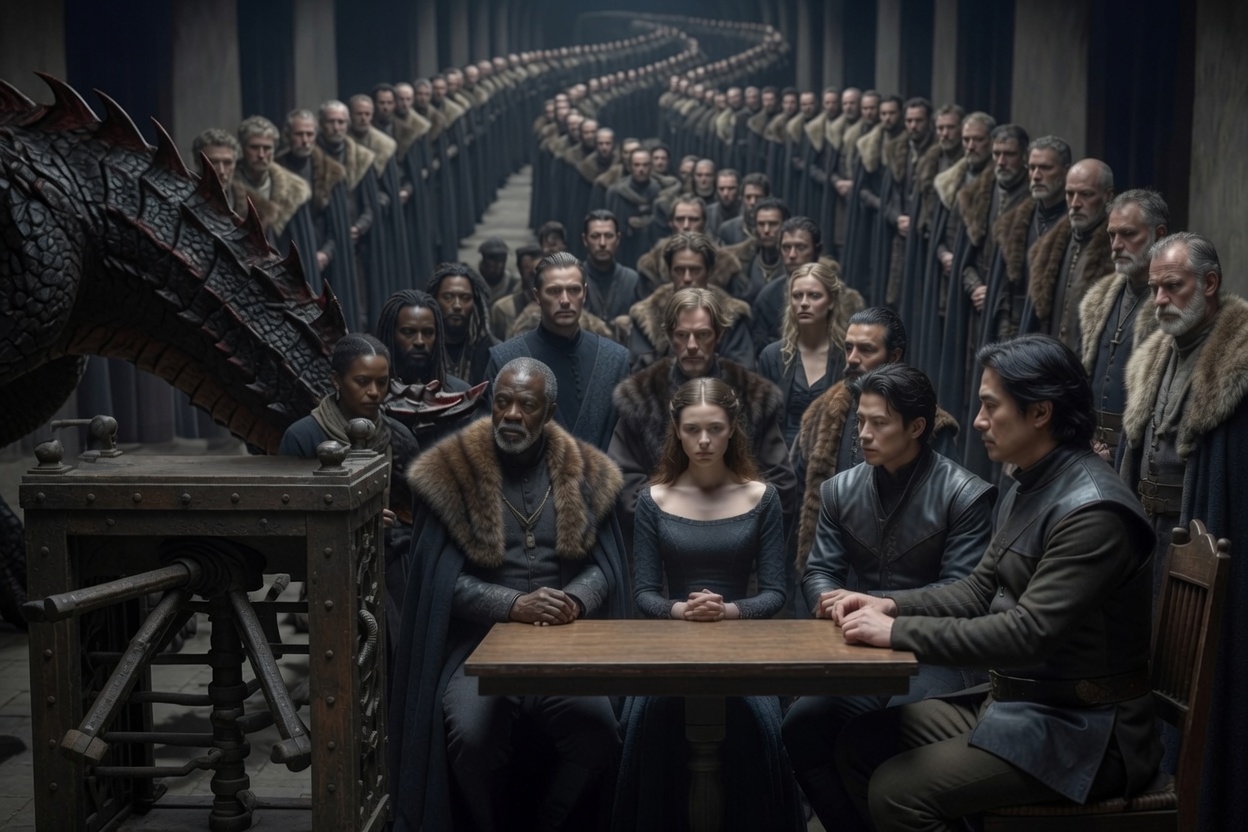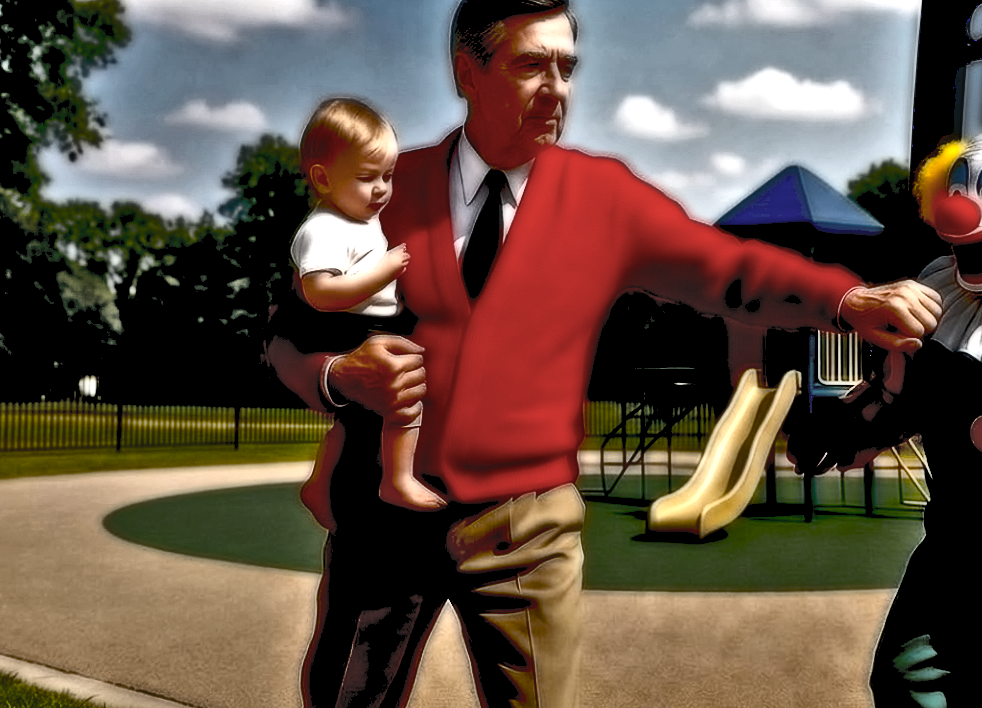
One manner, tuned to whoever stands in front of it — and, at the edge of the frame, the tradition he walked into a studio to oppose. Fig. 1
There is no formal statute requiring it, yet the convention operates with the force of one. Anyone who addresses the young on screen or stage is expected to adopt that peculiar register: the raised, singsong pitch, the exaggerated vowels, the forced brightness that signals, before a single coherent sentence has been uttered, that the listener is not quite a full person. It is the voice of the professional children's presenter, and it has become the default mode of public address to anyone under twelve. The assumption is that dignity is adult property; simplicity must be purchased at the price of condescension.
The convention did not fall from the sky. It descended from the carnival barker and the vaudeville clown, from a tradition in which the child audience was understood not as a gathering of persons but as a crowd to be worked. Early television inherited the assumption wholesale. The children's hour was a circus transplanted to the studio: the shouting host, the studio bleachers packed with squirming bodies, the frantic tempo calculated to prevent the terrifying possibility of a moment's silence. The child, in this model, is an appetite. One does not converse with an appetite; one feeds it, loudly, and hopes it does not wander off. The kid voice is the vocal residue of that model, and it has outlived every set and sponsor that produced it. It survives in classrooms, in pediatricians' offices, in the practiced coo of relatives at holiday tables, and above all in the media made for children, where it has been refined into something like an industrial standard. To speak to a child in one's ordinary voice has come to seem almost eccentric, a breach of professional etiquette, as though one had addressed a golden retriever in the language of a board meeting.
What is remarkable is how rarely the convention is examined. It is defended, when anyone bothers to defend it, on the grounds that children require simplicity, and this is true as far as it goes. A four-year-old cannot parse subordinate clauses stacked five deep; vocabulary must be chosen; pace must slow. But simplicity is a property of language, and the kid voice is not a property of language at all. It is a property of posture. It is possible to say something perfectly simple in a tone of complete respect, and it is possible to say something perfectly simple in a tone that announces, with every swooping vowel, that the speaker has temporarily suspended his own personhood because he judges the listener incapable of receiving the genuine article. The convention conflates the two, and the conflation is the whole problem. Simplicity is a courtesy. The voice is an insult wearing the courtesy's clothes.
Simplicity is a courtesy. The voice is an insult wearing the courtesy's clothes.
I. The refusal
Fred Rogers refused the bargain. He slowed his speech and chose his words with care so that a child could follow, but he never once confused simplicity with diminishment. He did not adopt the grotesque children's-presenter voice that turns the adult into a performing idiot and the child into an idiot's audience. He looked into the camera and spoke to one person. Not "the kids," not a demographic, not a room that required whipping into excitement. One child. The underlying message was never merely "You are special." It was: you are a person, your inner life is real, and I will behave as though speaking to you matters.
It is worth dwelling on how deliberate the refusal was, because Rogers has been so thoroughly converted into a plush icon of niceness that the rigor underneath is easy to miss. He came to television in the early 1950s not because he loved the medium but because he despised what it was doing. He had seen the pies in faces, the noise deployed as a substitute for content, and he concluded that a powerful instrument was being used to demean the very audience it claimed to serve. He trained as a musician and later as a minister, and when the Presbyterian church ordained him it did so with an unusual charge: to serve children and families through television. The show that resulted was not gentle by accident or by temperament alone. It was gentle the way a well-made watch is quiet — as the product of obsessive engineering. Rogers spoke slowly, well below the clip of ordinary broadcast speech, because he had thought about how long a young mind needs to take in a sentence and turn it over. His staff joked about the dialect they called "Freddish," the painstaking process by which every line was revised and re-revised so that it could not be misheard, could not frighten, could not accidentally shame. A sentence as innocent as an instruction about crossing the street would be rewritten half a dozen times until it carried no hidden trapdoor. This is not the behavior of a man being sweet. It is the behavior of a man taking his audience seriously — more seriously, line for line, than most writers have ever taken an audience of adults.
Fig. 2 — The Quiet Observation. Reading every word. Taking every letter seriously.
II. What the voice can carry
The seriousness extended to subject matter. The kid voice, by its nature, can only carry certain cargo. It can carry excitement, jokes, songs about counting. It cannot carry death, divorce, assassination, or fear, because its whole premise is that the listener must be protected from the register in which such things are discussed. Rogers, having declined the voice, was free to decline the premise. In the week after Robert Kennedy was shot, he went on the air and talked with children about what assassination meant, on the theory that they were hearing the word anyway and deserved better than the murmuring of adults over their heads. He devoted programs to the death of pets, to divorce, to the fear of being sucked down the bathtub drain — a terror no adult would think to dignify and no child fails to recognize. He could do this because he had never established a contract of forced cheer that such topics would violate. His ordinary register already had room for sorrow, and so sorrow, when it arrived, did not require a tonal betrayal. The clown voice paints itself into a corner; the human voice can go anywhere.
And the human voice, it turns out, can do things the clown voice cannot even attempt. In 1969, Rogers sat before a Senate subcommittee whose chairman, John Pastore, was openly impatient with the parade of witnesses defending public television's budget against proposed cuts. Rogers did not shout, did not perform, did not summon statistics. He spoke to the senator precisely as he spoke to the camera — slowly, directly, one person to one person — and described what he was trying to give children: the assurance that their feelings were mentionable and manageable. In a few minutes, a hostile chairman announced that he had goosebumps and that the funding was safe. The episode is usually told as a charming anecdote. It is better understood as a controlled experiment. The same address that honored the dignity of a five-year-old proved capable of moving a United States senator, because it was never a children's voice in the first place. It was a serious voice, tuned to whoever stood in front of it. That is the entire point. Rogers did not have one manner for children and another for power. He had one manner, and its name is respect.
The clown voice paints itself into a corner; the human voice can go anywhere.
Six minutes before a hostile chairman
Senator John Pastore had heard enough from public television's defenders. Rogers brought no statistics. He spoke as he spoke on the air — slowly, one person to one person — about feelings being mentionable and manageable.
Outcome: goosebumps, and the funding survived. Usually told as an anecdote. Better read as a controlled experiment.
III. Connoisseurs of condescension
That is the part almost no one copies. The cardigan, the soft tempo, the gentle manner — these travel easily. The dignity does not. Rogers understood that a child does not need to be spoken to like a clown in order to grasp that the world contains warmth. He treated the camera as a direct line to a single consciousness, and in doing so he granted that consciousness the same standing he would have granted an adult. The effect was not sentimentality; it was recognition. Watch the imitators and the difference declares itself within seconds. They have the props and the pacing, but the eyes are performing, and a child can tell. Children are, in fact, connoisseurs of condescension. They cannot name it, but they register it with the accuracy of a seismograph, because they are subjected to it constantly and have every incentive to learn its signature. The kid voice does not fool them. It merely teaches them what adults believe about their standing — teaches them, before they can read, that the world has sorted them into the category of creatures who are managed rather than addressed. Rogers's audiences sensed the opposite lesson, and they sensed it physically. Grown men and women who met him decades later routinely found themselves in tears within a minute, not because he was famous but because some six-year-old self inside them recognized the one adult who had never talked down.
Even Bill Cosby, a man whose character has since been revealed as deeply compromised, once found himself in the same ceremonial orbit as Rogers and seemed, for a moment, to register the difference. At the 2002 Presidential Medal of Freedom ceremony both men were honored; the following New Year's Day they shared the role of grand marshal of the Rose Parade. Cosby, never one to miss a comic opportunity, produced Rogers's signature sweater and sneakers when the man himself was absent, and later recalled the crowds calling out "Welcome to the neighborhood." One could almost imagine the gesture as a reaching upward, an acknowledgment that Rogers occupied a higher plane. It matters that Cosby was, at that moment, at the summit of a career built substantially on children — the cartoon, the pudding commercials, the sitcom father presiding over America's most-watched living room. He was, by the market's measure, the most successful communicator with children and families of his generation. And yet there he stood, holding another man's cardigan like a relic, playing the acolyte. The comedy of the gesture depended on the audience understanding a hierarchy that no ratings chart recorded: that whatever Cosby had built, Rogers had built something of a different order entirely. Cosby's own subsequent disgrace only sharpens the contrast. The revelation of what he was in private did not merely destroy his reputation; it retroactively exposed his public warmth as a performance, an instrument, a costume in the fullest sense. Rogers's warmth has been subjected to the same posthumous scrutiny — journalists and biographers went looking, half in dread and half in hope, for the crack in the facade — and they found a man who was, by every account, more himself off camera than most people manage to be on it. The neighborhood was not a set he walked off of. Whatever else Cosby was, he recognized, at least in that public proximity, that Rogers was not playing the same game.
IV. Tone is curriculum
The enforced kid voice does the opposite of what Rogers did. It announces that the child is not yet worthy of ordinary human speech. It is a form of soft contempt dressed as affection. The adult performs idiocy so that the child will feel entertained, and in the process both parties are diminished — the child, because he is told in the medium itself that he cannot yet be trusted with a real person; the adult, because he has consented to become a puppet of his own condescension, grinning through a register he would be humiliated to use with anyone he respected. And the contempt is not inert. Tone is curriculum. A child marinated in the bright, empty voice learns that this is what attention from grown-ups sounds like, that enthusiasm is a currency to be pumped rather than a response to something genuinely delightful, that the appropriate posture before an audience is frenzy. The lesson has never been taught more efficiently than now. The algorithmic children's content that autoplays across a billion screens is the kid voice perfected and automated: the shrieked greeting, the artificial gasp, the tempo calibrated by retention graphs to seize a toddler's attention and never once risk releasing it. Rogers famously let silence sit on the air — he once spent a full minute of national television watching a kitchen timer count down, on the theory that a minute is worth knowing the length of. No algorithm would permit it. Silence is churn. The economics of attention have taken the old circus premise — the child as appetite — and given it infinite pies to throw.
Fig. 3 — Fred at the fish tank.
Rogers never made that trade. He spoke as if the child's capacity for seriousness was already present and merely required invitation. This is the deepest difference, and it is a difference of anthropology before it is a difference of style. The kid voice assumes that the child is a pre-person, a creature in the larval stage, to be amused now and dignified later, once dignity has been earned by the passage of years. Rogers assumed that the person was already there — incomplete in knowledge, certainly, limited in vocabulary, but whole in standing, possessed of an inner life as real and as weighty as any adult's, and entitled therefore to the same fundamental courtesy: the courtesy of being addressed rather than handled. Every technique on the program flowed from that single assumption. The slowness was not softness; it was the pace at which one speaks to someone whose understanding one actually cares about. The direct gaze was not a trick of intimacy; it was the physical grammar of address to an equal. Even the daily ritual of the sweater and the sneakers, so easily mocked as fussiness, was a form of respect: he changed his clothes on camera because visits have beginnings, and a person one takes seriously is owed the signal that the visit has begun.
V. A title of parity
"Won't you be my neighbor?" was not a marketing slogan or a ritual of forced cheer. It was an offer extended to an equal — an invitation, in the full and old sense of the word, which presumes in the invited party the standing to accept or decline. One does not invite an appetite. One does not invite a demographic. One invites a neighbor, and neighbor is a title of parity: it says nothing about age, accomplishment, or size, only about mutual standing on common ground. The only proper reply is the one that treats the invitation with matching gravity: Anytime, sir. Anytime. Not yes, because one has been summoned, but anytime, because one has been addressed as someone worth inviting.
One does not invite an appetite. One does not invite a demographic.
Half a century after the program first aired, that standard remains the exception. The technology has changed, the sets have changed, the pies arrive now at sixty frames per second, but the governing convention is the same one Rogers walked into a studio to oppose: the raised pitch, the swooping vowels, the brightness that precedes and preempts the sentence. It persists not because anyone has argued for it but because no one is required to; conventions of contempt rarely submit themselves for review. Yet the counterexample stands, complete and documented, thirty-one seasons of proof that a child can be offered simplicity without surrendering an ounce of dignity, and that the offer, once made, is never forgotten by its recipient. The rule continues to be the clown voice, and the rule is wrong.