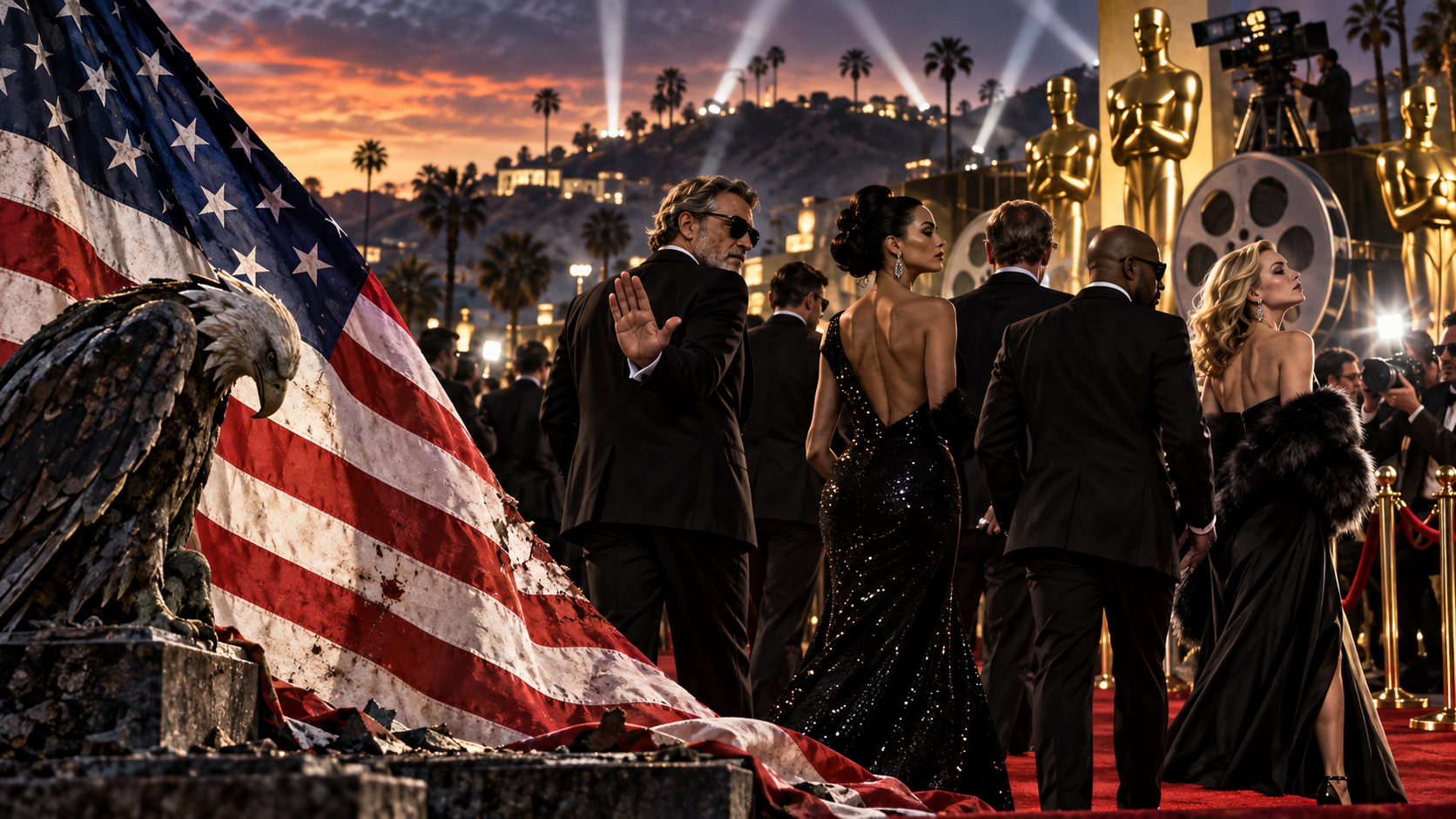
RECREATION Illustrative image. Not a photograph of the event. Matières Fécales finale · Place de la République · 28.09.2026
They Really Hate Us
At Paris Fashion Week, a finale of white men worn as fur, and an industry on its feet, applauding.
On Monday night, 28 September 2026, in Paris, the fashion world gathered in Place de la République to watch white men worn as fur. At the finale of Matières Fécales' "The Ninety-Nine Percent," models circled the statue of Marianne with limp white bodies slung over their shoulders like fox stoles, trophies of the hunt. And the crowd applauded. The critics swooned. Powerful, they said. Moving. Revolutionary.
Revolutionary. Remember that word. Place de la République has heard it before, and it has always ended with bodies.
The derangement
Let's not pretend this is sane. Two designers sat in a studio, looked at the world, and decided the most urgent message they could send was a parade of lifeless white men draped over shoulders like pelts. They sketched it. They sourced the figures. They cast it, rehearsed it, lit it and staged it at a national monument. At no point in that process did anyone say: this is sick.
Nobody gets there by accident. It takes a mind so marinated in grievance that it can look at a group of people and see skins. The figures had no names, no faces, no crimes. They weren't guilty of anything except being what they were. That was the point. You don't need to prove a type did something wrong. You only need to hate it.
“You don't need to prove a type did something wrong. You only need to hate it.”
The audacity
They'll tell you it's about class. The ninety-nine percent against the one percent. Then explain the casting. Ninety-nine models, every one a person of colour, and the designers bragged about it. Every figure standing in for greed and power: a white man. That isn't a critique of wealth. It's an equation, wealth equals white, whiteness equals guilt, written in bodies and paraded in public.
And look who's holding the pen. Matières Fécales dresses Zendaya, Lady Gaga and Kylie Jenner. It started out mocking luxury and became luxury, as even Salon admitted in August. Its clothes went to the Met Gala on Sarah Paulson as an anti-rich statement, while she sat on a fortune of her own. The billionaire in the front row gets a gown. The billionaire in the finale gets turned into a stole. The difference isn't money. You can see the difference from the back row.
Last season they dressed the rich as demons, with bloodied "guilt gloves" and blacked-out eyes. This season they skinned them. What exactly is next season supposed to look like?
The society that claps
The designers are the symptom. The applause is the disease.
Not one major fashion outlet called the finale what it was. Not one editor wrote the obvious sentence. Instead they reached for the thesaurus: raw, brave, urgent, necessary. Rihanna showed up. The City of Paris handed over one of its most sacred public squares for the occasion. Every institution that might have said "enough" said "encore."
Why? Because an entire class of tastemakers has decided that white men are the one target you can hit as hard as you like and still be praised for your conscience. They call it punching up. It's a license, and they know it. Dehumanize anyone else on a runway and careers end by morning. Do it to white men and you get a standing ovation and a Vogue review.
“Every institution that might have said ‘enough’ said ‘encore.’”
And the joke is on the people who can least afford it. The men in that finale weren't really billionaires. Billionaires will never feel a thing. The ones who feel it are the bus drivers, the electricians, the farmers, the pensioners, the men who look like those figures and earn a fraction of what one of those gowns costs. They saw the image. They understood it perfectly. They were meant to.
Fashion says it's about inclusion. On Monday night, inclusion meant ninety-nine people on the runway and one group worn as fur, and the most powerful people in the industry on their feet, cheering.
They really do hate us. And did they ever really attempt to hide it?
The counterpoint
A counterpoint was offered that the designers and most reviewers see the show as a critique of extreme wealth rather than of white people, noting that billionaires are overwhelmingly white and male, and that the all-POC casting reflected Bhaskaran's own immigrant upbringing and a push for representation.
I. It converts a racial tableau into a class alibi after the fact. The finale was not a spreadsheet of net worth. It was two living models of color carrying limp, nameless, faceless white male bodies like pelts, eyes taped with money, around Marianne. If the argument were “extreme wealth,” the bodies could have been bodies of wealth: gold, bloated, branded, multi-ethnic, anonymous suits. They were not. They were typed as old white men. The living line was typed as not-white. That is the design, not an accident of demographics. Calling it “class” after you have already cast race as the skin of the enemy is how you keep the hunt and claim the sermon.
II. “Billionaires are overwhelmingly white and male” is the oldest scapegoat move in a new font. Overrepresentation at the top is not a warrant to exhibit a whole type as carcass. The same sentence has been used against every group that ever clustered in a disliked elite: Jews in finance, Chinese in Southeast Asian commerce, Indians in East Africa, Armenians, Lebanese. The pattern is always: name a real statistical bulge, then treat the bulge as the essence of the people, then stage the people as objects. The counterpoint pretends this is analysis. It is selection. Global extreme wealth is not a white-only club. Gulf sovereigns, Indian conglomerates, Chinese princelings, and tech fortunes that are not “old white men” exist. The show did not carry those. It carried the one figure current fashion is allowed to kill in public.
III. It lies about who the 99 percent are. Most of the people who will actually absorb that image are not sitting on a fortune. They are the men the essay names: drivers, trades, pensions, the faces that look like the stoles. The 99 percent in France, Britain, the American interior, and Eastern Europe is not an all-POC cast. Using “representation of my housing project” to justify an all-POC living army and an all-white dead cargo is not inclusion. It is a racial filter on who counts as the oppressed and who counts as the pelt. Class language is being used to smuggle a racial sorting rule: our people walk; their people are worn.
IV. The casting boast gives the game away. Bhaskaran did not hide it. Ninety-nine models of color, ninety-nine looks by a designer of color, friends and family from social housing — stated as the point. That is not a neutral documentary of poverty. It is a claim about who belongs in the square of the Republic and who belongs on the shoulder. A critique of capital that requires the victims of capital to be one race and the emblems of capital to be another is not a critique of capital. It is a myth of who dirties the world.
“Our people walk; their people are worn.”
V. The applause rule is the tell. Swap the races of the trophies and the show does not get “raw” and “necessary.” It gets cancelled by morning. The counterpoint needs you not to notice that asymmetry. “Punching up” here means: the only group you may display as hunted meat without professional death is white men. That is not courage. It is a protected cruelty. Institutions that would never stage Black bodies as stoles, or Jewish bodies, or women’s bodies, will rent Place de la République for this and call it conscience. The counterpoint exists to keep that double standard from having to say its name.
VI. Personal biography does not sanctify a public lynching. It is not a license to turn a national monument into a pageant where one ancestry is the human circle and another is the trophy. Representation that only runs one direction — we are family, they are pelts — is not justice. It is a hierarchy with better lighting.
So the counterpoint is profoundly evil in the ordinary sense, as it is the language that lets a crowd cheer dehumanization while congratulating itself for having the correct enemies. It does not refute the image. It launders it. Wealth was the caption. Race was the costume. The caption is what they want you to argue about so you never have to look at who was slung over the shoulder.
Don’t hate me because I am white but hate me because I am rich and white? Holy shit. Fuck off.