The Stitch
That Bound Us
How Victorian fashion functioned as a rigid system of social signalling — one that tried to preserve class distinction even as the sewing machine democratised clothing and blurred the visual markers of status.
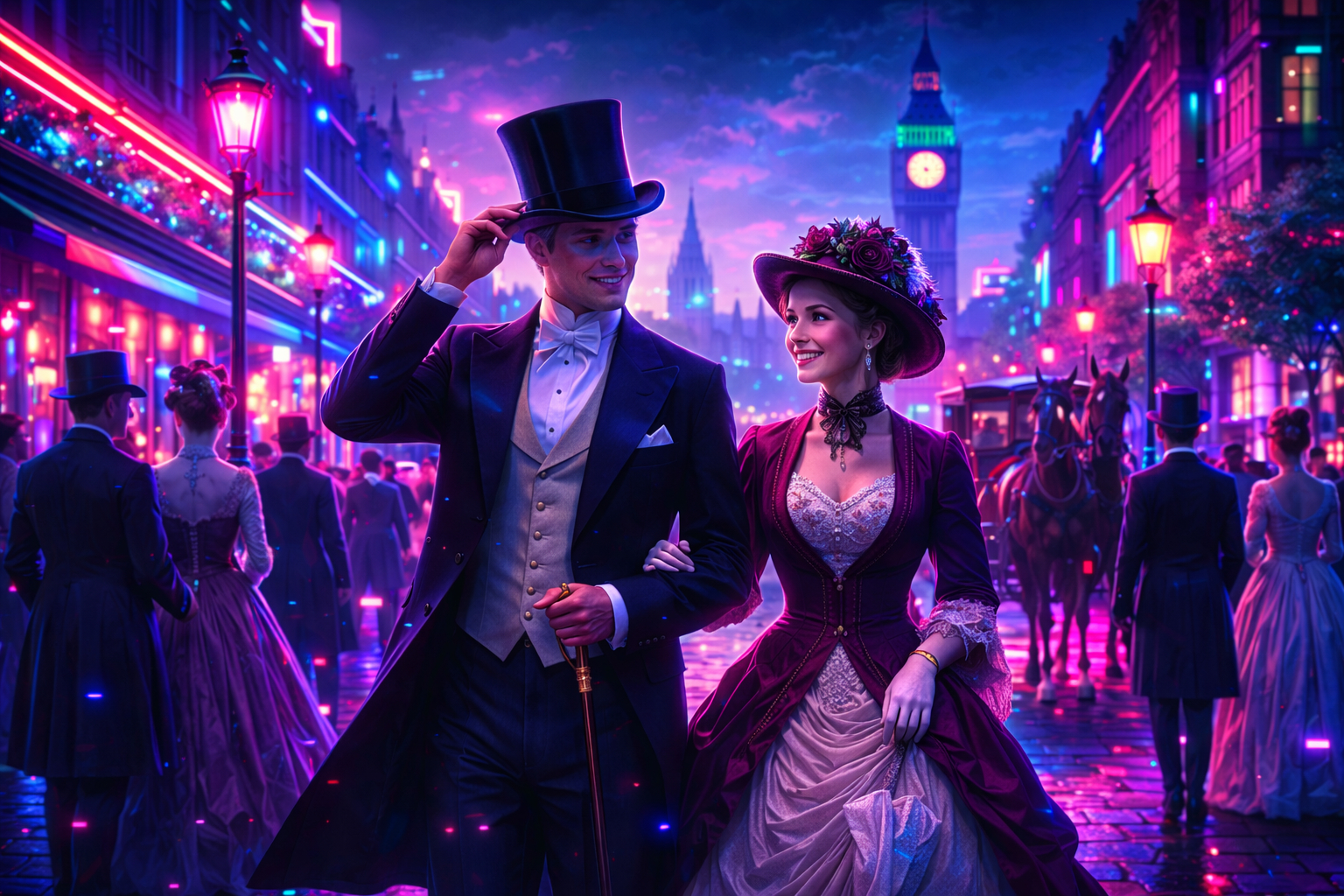
One cannot help but observe, with a certain weary amusement, how profoundly the human animal relies upon its plumage to negotiate the treacherous terrain of social intercourse. For centuries, clothing has served not merely as protection against the elements but as a silent arbiter of worth — a visible ledger of hierarchy that dictated who might be approached, who deferred to, and who, in the end, commanded the deference of others.
In the Victorian age, this function reached a pitch of exquisite refinement — or, depending on one's perspective, exquisite absurdity — where the cut of a coat or the fall of a skirt could elevate or condemn with the finality of a judge's gavel.
Consider the gentleman of that era, that paragon of restrained masculinity. His frock coat, severe and symmetrical; his trousers uncreased and unyielding; his collar high and starched to the point of discomfort — these were not mere garments but armour in the daily skirmishes of class and propriety.
He did not strut like the peacock of the Regency; he stood, immovable, as if carved from the same mahogany that furnished his club. This severity was no accident. In an age of industrial upheaval, when fortunes rose and fell with the speed of a steam engine, the gentleman's dress became a bulwark against the vulgar tide of new money.
And what of the lady he ostensibly protected and certainly defined? She was the counterpoint, the creation that completed his performance — swathed in crinoline and corsetry, embodying a fragility at once alluring and imprisoning.
This was no mere fashion; it was architecture. The lady's dress constructed a pedestal upon which she was placed, visible to all as the repository of domestic virtue. To appear in public improperly dressed was to invite ruin; the wrong hemline or the absence of a bonnet could signal availability, moral laxity, or worse — a descent into the ranks of those who laboured visibly.
Two Figures, One Machine of Meaning
Annotated plate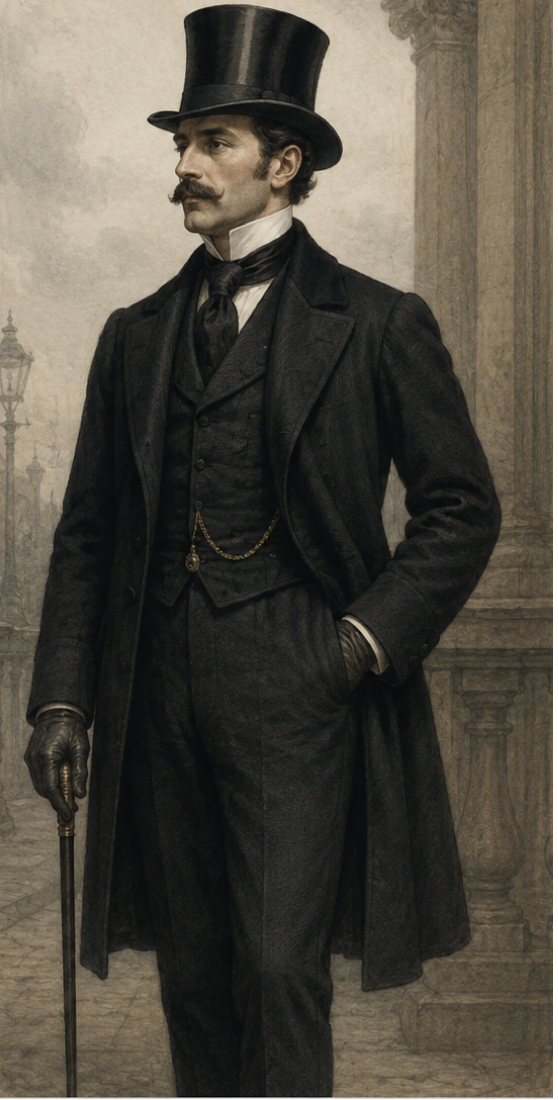
- 01Top hat. Vertical authority; height read as station.
- 02Starched collar. Discomfort as proof of leisure.
- 03Sober cloth. Wool in black, char, bottle; colour surrendered to gravity.
- 04Unmarked hands. Gloves: the absence of labour, advertised.
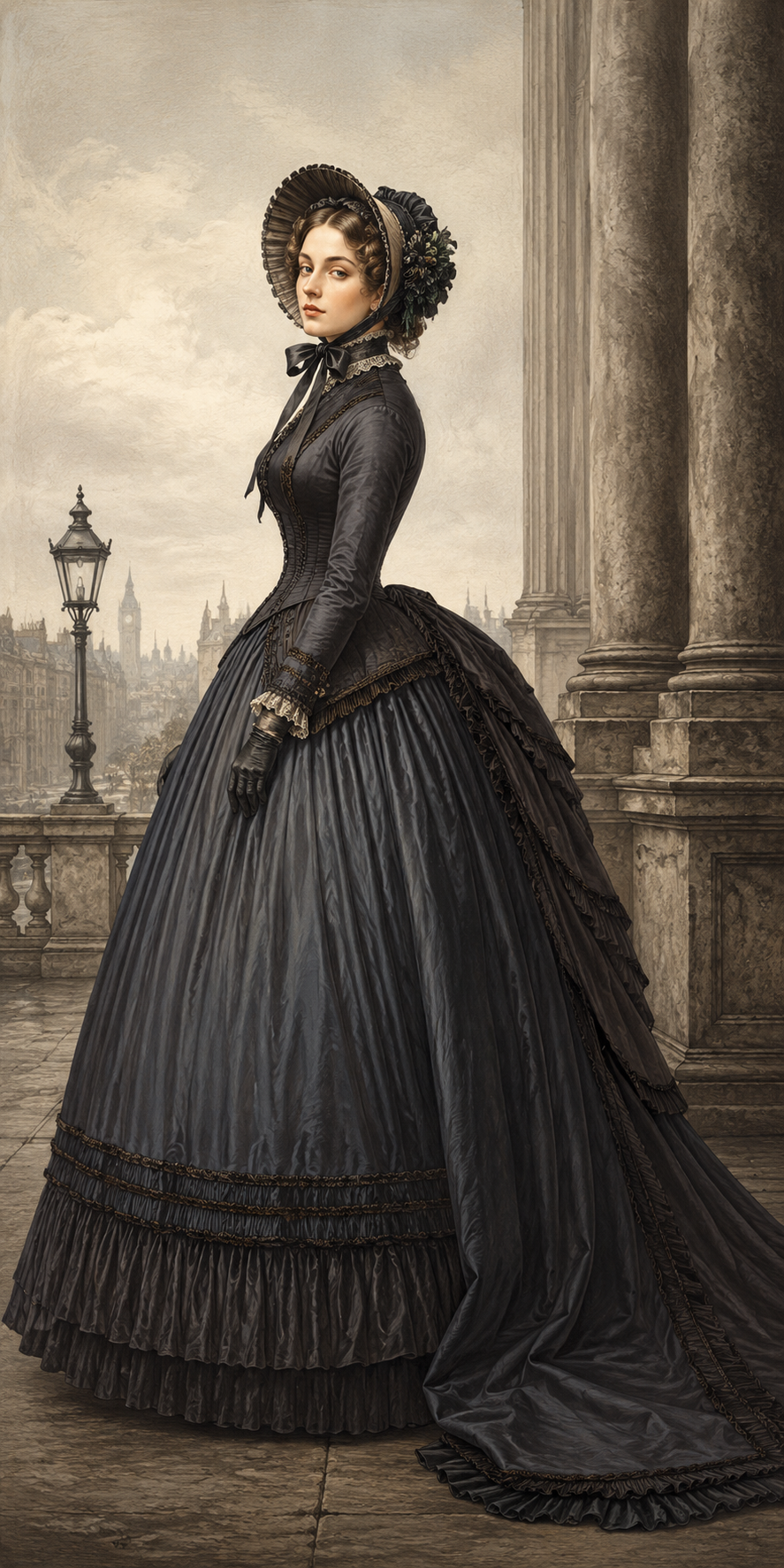
- 05Bonnet. Sightlines narrowed; the gaze governed at source.
- 06Corset. An hourglass built, not born; breath as expenditure.
- 07Crinoline. A perimeter of some six feet — proximity licensed by cloth.
- 08Trained hem. Movement reduced to a glide; the pedestal, portable.
Hours at the Needle
Hand vs. lockstitch machineSewing time per garment, as reported in mid-century manufacturers' trials. The figures were promotional — and still the order of magnitude held. A gown that had consumed a fortnight of a seamstress's sight could be run up in an afternoon.
The Quiet Revolution — A Timeline
1790 — 1901Thomas Saint patents a machine for leather. It is never built. The idea waits half a century for its moment.
Paris tailors destroy Barthélemy Thimonnier's workshop, fearing the machine will take their trade. They were not wrong.
Elias Howe patents the lockstitch — a mechanism that mimics the hand and outpaces it fivefold. The hinge of the century.
Isaac Singer turns a workshop curiosity into furniture, then into hire-purchase. The machine enters the parlour.
Butterick sells sized paper patterns by post. The silhouette of the drawing room arrives in the terraced house.
Etiquette manuals proliferate like sermons. What cloth can no longer prove, conduct is drafted to enforce.
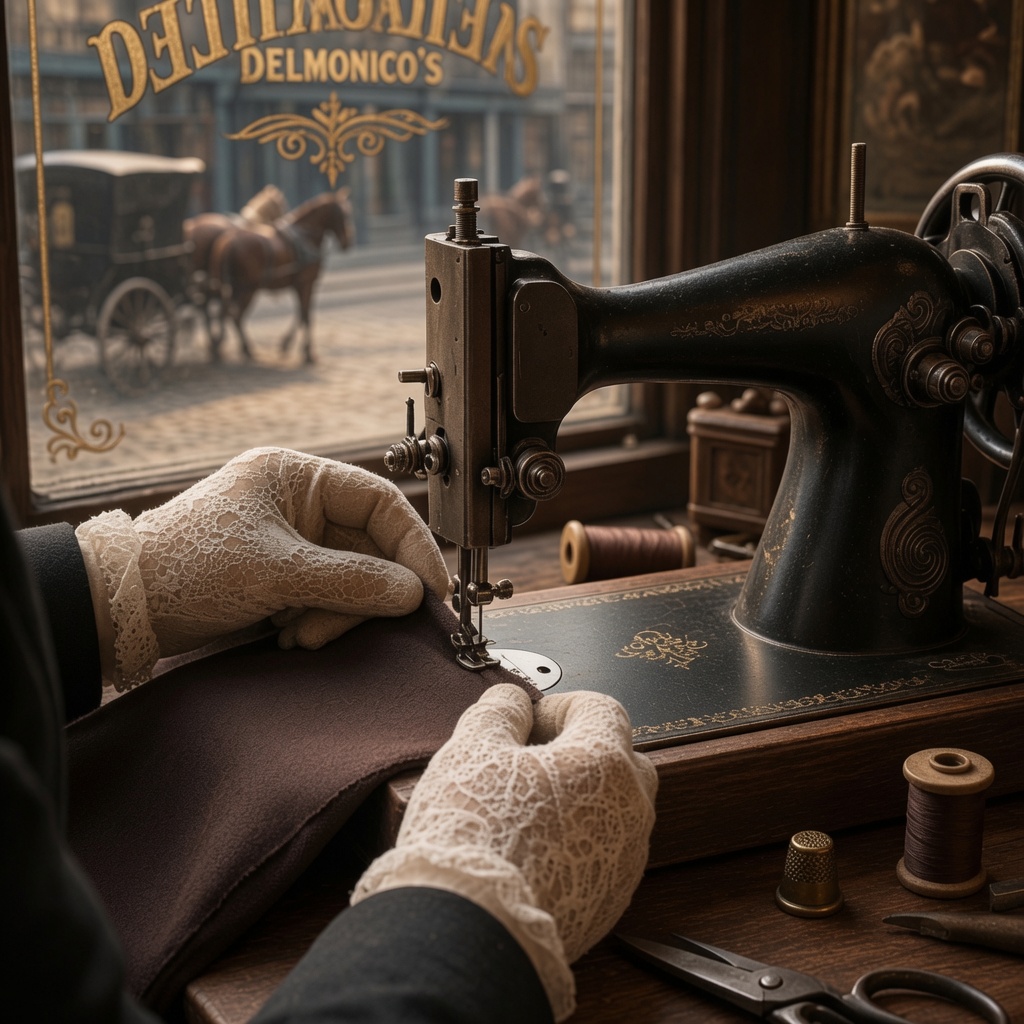
The arrival of the sewing machine altered the calculus irrevocably. Garments that once required weeks could now be produced in days; ready-made clothing, once the mark of the pauper, became available in standardised sizes and respectable fabrics.
Suddenly the clerk could purchase a coat that aped the gentleman's; the shop girl could aspire to skirts that echoed the lady's silhouette. A man in a machine-tailored suit might be a captain of industry or merely his secretary — one could no longer tell at a glance. Women, too, found themselves in garments that approximated the fashions of their betters, though often in cheaper cottons dyed with the new aniline colours that screamed novelty rather than pedigree.
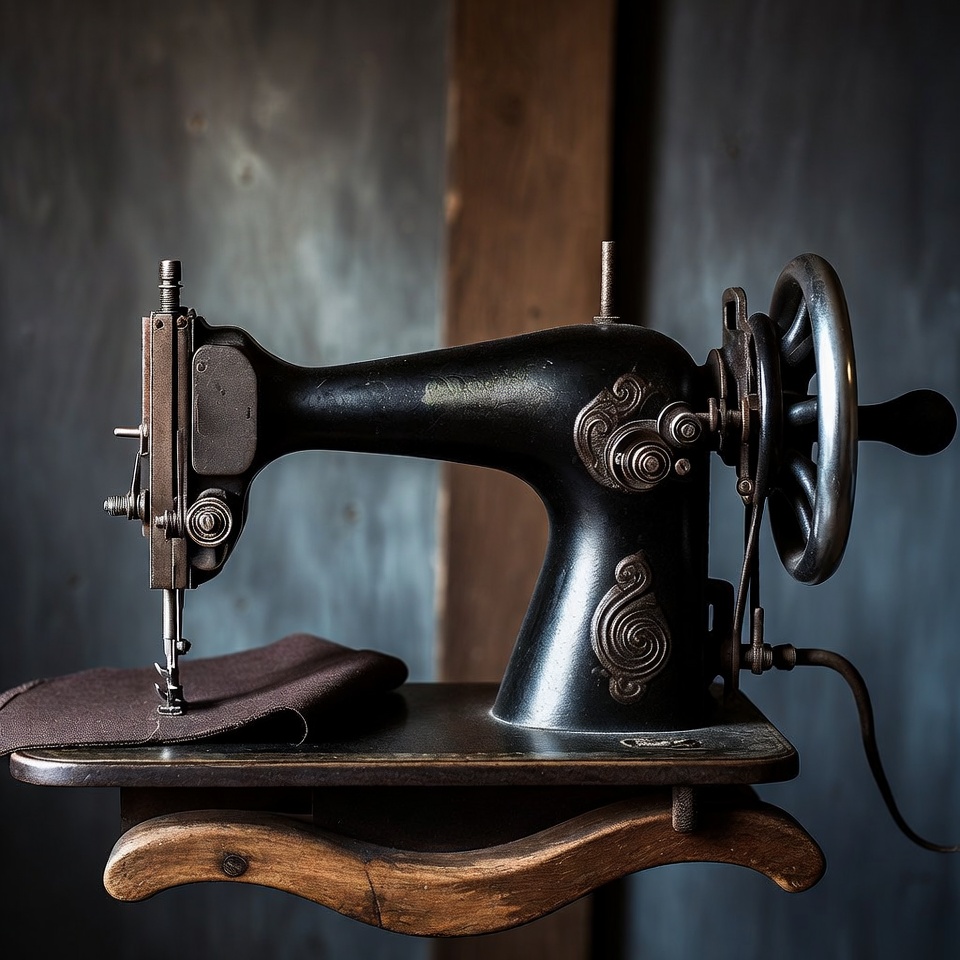
"Great style arrives neither early nor late, but precisely when society requires it to shore up its illusions."
No. 14
Fol. 06
The Ledger of Signals
What each marker was made to carryEtiquette became more rigid precisely because dress had become less reliable. As the garment lost its power to prove station, the burden shifted onto smaller and smaller particulars.
| Marker | Before the machine | After the machine | Reliability as a signal |
|---|---|---|---|
| Cloth | Silk and fine wool: months of labour, unmistakable. | Mill-woven, machine-sewn, sold ready-made in sizes. | Collapsed |
| Cut | Bespoke to one body by one hand. | Graded paper patterns, sold by post. | Weakened |
| Colour | Natural dyes; deep hues costly and rare. | Aniline mauve and magenta, cheap and everywhere. | Inverted |
| Conduct | Assumed to follow from dress. | Codified: calling cards, the angle of a glove, the hour of a dress. | Ascendant |
| Hands | Roughened by work, or gloved and idle. | Unchanged — the one marker the machine could not forge. | Intact |
The Final Unravelling of the Thread
In this light, the Victorian gentleman and his lady appear less as ideals than as anxious guardians of a fading order. He, with his sombre uniformity, sought to project an authority that no longer derived unambiguously from birth or wealth. She, confined in whalebone and wire, embodied a purity that required constant advertisement because the boundaries it policed were eroding.
The sewing machine, that humble contraption of needle and thread, exposed those illusions for what they were: stitches in a fabric that could, with sufficient ingenuity, be replicated by anyone.
We inherit the consequences still. Dress continues to signal, but its signals are muddled by mass production and the endless churn of trends. Decorum persists, though attenuated, in the subtle hierarchies of brand and cut.
One wonders what the age would have made of our own casual disarray, where the billionaire appears in denim and the labourer in logos. Perhaps they would recognise, with a shudder, the final unravelling of the thread they so desperately knotted.