
Difficulty in accessing a broadcast is not merely an annoyance; it is a measurable signal about the health of a distribution system. The UFC’s 2026 migration to Paramount+ was designed to eliminate the sport’s most persistent structural friction: the layering of seventy- to eighty-dollar pay-per-view charges over an existing ESPN subscription, and the fragmentation of a single card across multiple services. Under the new arrangement, Paramount holds the complete American package, thirteen numbered events and thirty Fight Nights, consolidated under one subscription with selected events simulcast on CBS. As a matter of pricing architecture, the model is difficult to criticize.
As a matter of delivery, UFC 330 exposed the gap between the architecture and its execution.
Paramount’s published viewing instructions describe a straightforward path: install the application on a television or device, navigate to the UFC hub, watch the event live, and, if any portion is missed, retrieve it on demand shortly after conclusion. In practice, the experience diverges from that description in ways that are technically specific and worth cataloguing. On Roku, the UFC section can present stale content states, surfacing a previous card while the current event is visible but unresponsive to a play command. Browser access can require a separate authentication flow depending on the channel through which the subscription was purchased, a symptom of entitlement systems that do not reconcile cleanly across billing partners. And once the live window closes, the event is decomposed into discrete video-on-demand objects. Paramount’s own guidance directs viewers seeking replays to an “episode guide” to locate individual fights.
That last design decision reflects a category error about the product being distributed.
A UFC card is not a set of independent programs that happen to share a release date. It is a continuous, sequentially dependent event whose meaning accrues over roughly four hours. A contested decision early in the evening colors the reception of the bouts that follow. A concussive knockout alters the perceived stakes of the next fight. A veteran’s decline and a prospect’s emergence are legible only in relation to one another. A fighter who is anonymous at six in the evening can, by ten, become the defining memory of the card. The continuity is the product. A delivery system that segments the evening into episodes and requires the viewer to reassemble the sequence has optimized for the wrong unit of consumption.
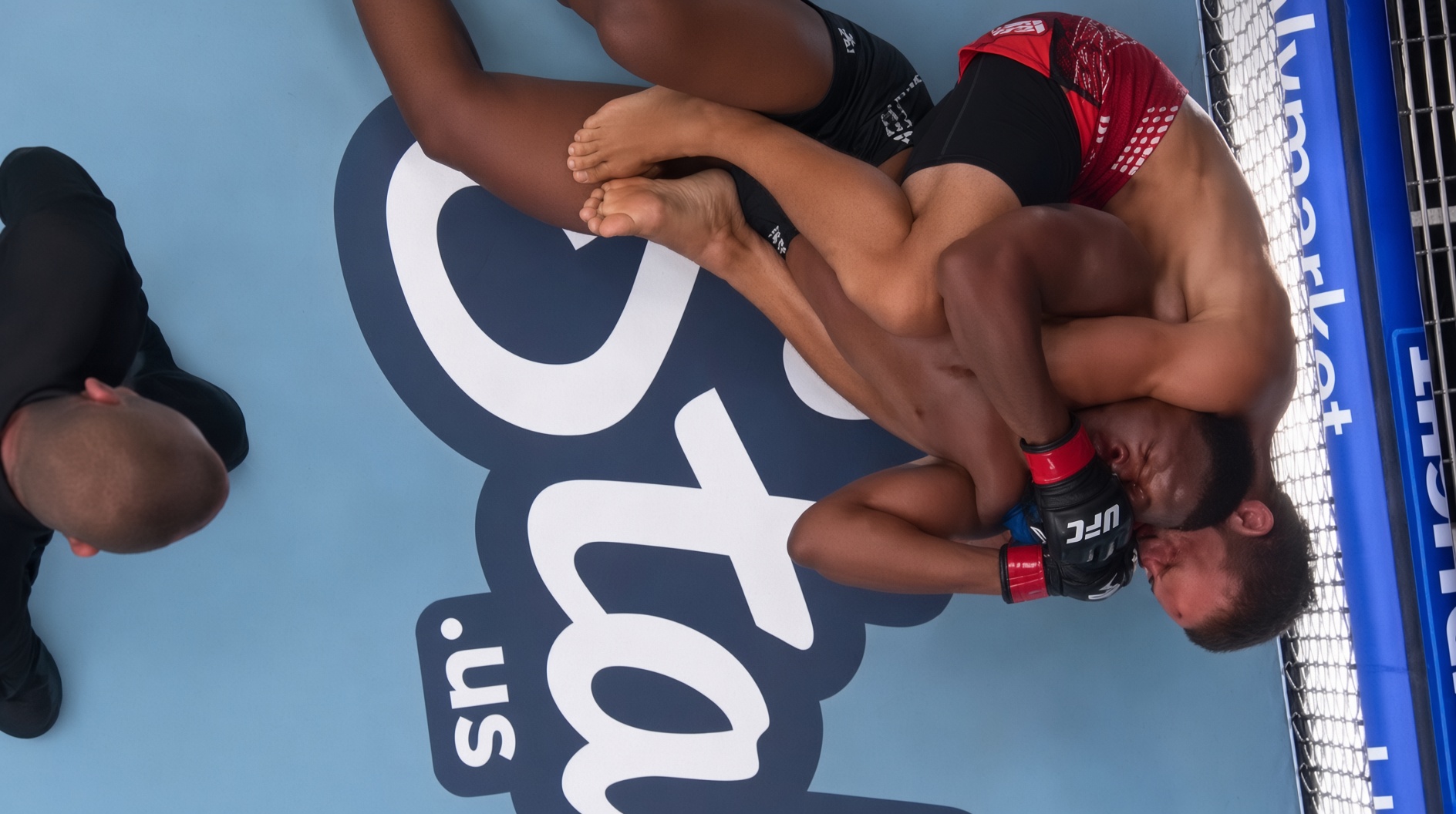
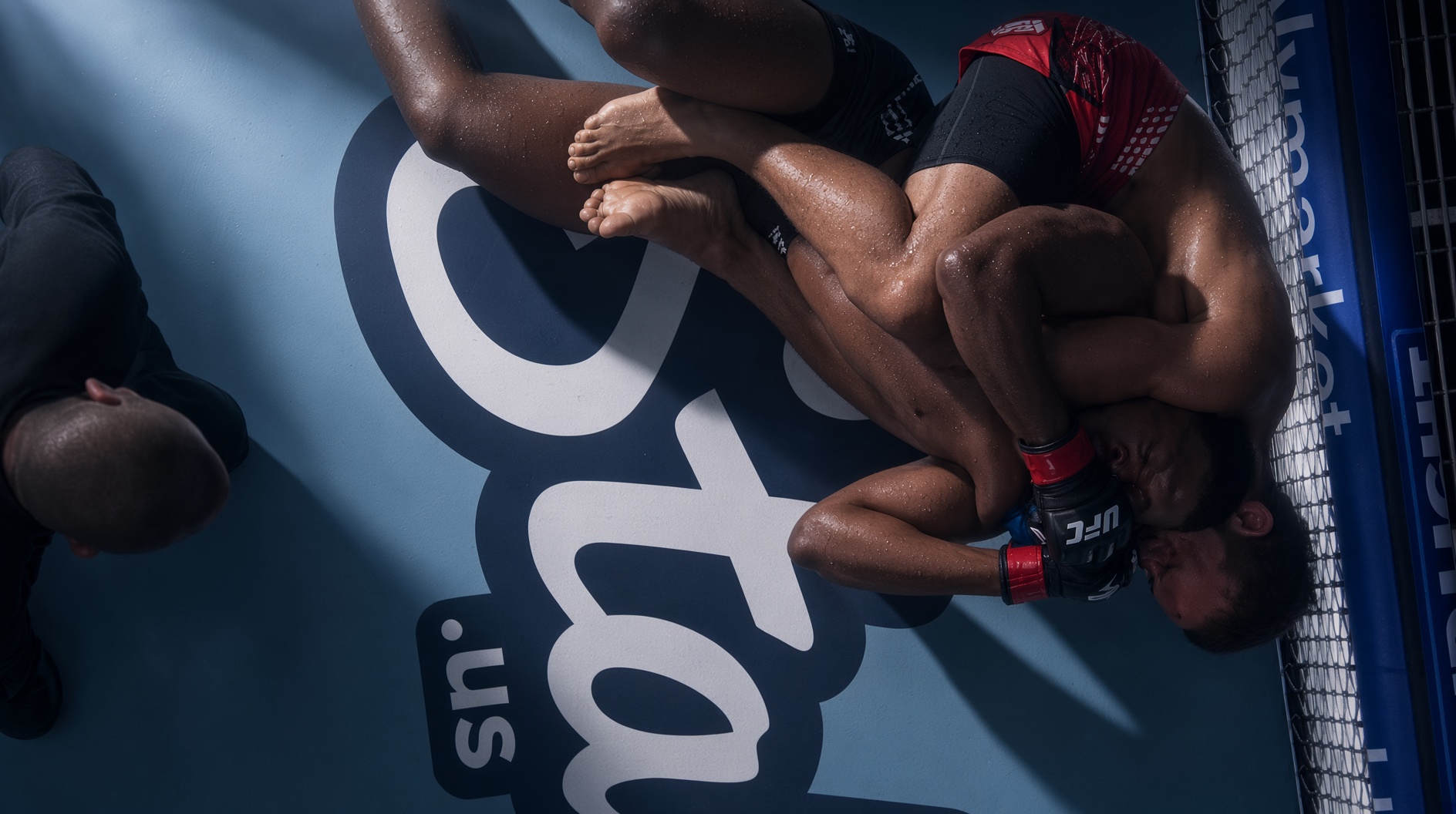
The Stoltzfus–Abdul-Malik bout demonstrated why the distinction matters.
“The continuity is the product. A delivery system that segments the evening into episodes has optimized for the wrong unit of consumption.”
STOLTZFUS def. ABDUL-MALIK
185 LB
THE REVERSAL
THE ANSWER
“We’re just normal people in here. I feel so out of place sometimes, but it’s amazing to come in here in front of all you guys and walk away with a performance like that so close to my hometown.”
This is the central epistemological problem in evaluating fighters. Observers rely on visual proxies — build, posture, hand speed, youth, aggression — as shorthand for outcomes that have not yet occurred. The proxies are correlated with results but not determinative of them, and the correlation weakens precisely in cases where a fighter’s competencies are grappling-based, durability-based, or otherwise invisible until contact.
The sequence above illustrates a phenomenon that combat sports render with unusual clarity: the persistence of the supposedly ordinary competitor after the hierarchy has presented all of its credentials. This is the structure the original Rocky was attempting to capture before the franchise reduced it to a narrative about winning. The underlying appeal is stranger and more durable. Everyone agrees beforehand on what should happen. The stronger, younger, better-constructed competitor demonstrates each of the advantages that were predicted. And the ordinary man is still standing, and then he is not merely standing but imposing his own terms.
Beneath the rankings, broadcast packages, promotional strategy, pound-for-pound debates, gambling integrations, and multibillion-dollar rights economics, prizefighting retains a question that resists complete modeling: what happens when these two individuals fight? One can possess nearly all relevant information and still not know the answer. That irreducible uncertainty is the sport’s fundamental value proposition.
UFC 330 contained higher-stakes bouts. Ian Machado Garry could reasonably argue that the main-event scorecards misrepresented what occurred. Mackenzie Dern’s grappling remains one of the sport’s distinctive technical spectacles, the product of a jiu-jitsu education that began in early childhood under her father and now manifests as an ability to control and submit professional fighters through positional sophistication rather than athletic superiority. Those results carried consequence. But Stoltzfus was the reason the evening justified its friction: the failed login, the reopened application, the fallback to browser, the stale television interface, the play command that produced no playback, and, for those unable to watch live, the reconstruction of a continuous event from a segmented episode list.
The post-fight interview reinforced the point. Stoltzfus had every incentive to adopt the modern athlete’s rhetorical playbook: identify a target, assert disrespect, demand a ranking, convert grievance into brand equity. He had entered as one of the card’s largest underdogs with his roster status in question, defeated the prospect he was ostensibly matched to elevate, survived being hurt, and finished the fight by submission in Philadelphia, near his home. Instead, he praised his opponent (“Mansur is a beast”) and expressed hope that they could train together again.
Gratitude, an absence of self-promotion, a stated sense of not belonging, and a demonstrated capacity to defeat nearly anyone he will encounter in a cage. That combination is more compelling than any personality framework a promotion could engineer, precisely because the danger is uncorrelated with its presentation. Stoltzfus does not perform toughness because toughness is simply among his attributes; the credibility of the threat is heightened by its invisibility in his social bearing.
Paramount has paid a considerable sum for the right to deliver such moments: the seven-year American agreement was valued at approximately $7.7 billion. The underlying thesis is well established in media economics. Live sports resist the time-shifting and fragmentation that have eroded linear television because the content is perishable, and committed audiences follow their sport across platforms.
That second premise should concern Paramount more than reassure it. Audience loyalty of the kind UFC commands is strong enough to mask substantial product failure. Consider two viewers, each of whom spends twenty minutes attempting to initiate playback. The first, seeking a film, abandons the attempt and is recorded as churn. The second, seeking a fight, persists, eventually succeeds, and is recorded as a successful viewer. The telemetry cannot distinguish satisfaction from endurance. Aggregate engagement metrics will therefore overstate the platform’s performance in exactly the segment where the content is most valuable, because those viewers tolerate friction that other audiences would not.
The strategic risk for any rights holder is mistaking the resilience of the underlying product for validation of the delivery mechanism. If viewers repeatedly overcome an interface because the alternative is missing the event, their eventual presence in the stream is evidence that the event succeeded, not that the interface did.
On Saturday, the event succeeded. Dustin Stoltzfus entered a cage against a man nearly everyone expected to beat him, absorbed his best offense, answered it, took him to the ground, secured his back, and made him submit. Then he thanked the audience for the opportunity. Paramount’s sole obligation was to show it, and that remained the difficult part.
THE REST OF THE CARD
↑ BACK TO THE FEATURETwelve bouts, briefly. Eight ended inside the distance. The championship double-header went the full fifty minutes.