The Premise of the Miracle
From 1978 to roughly 2012 the People’s Republic of China executed what is routinely described as the greatest poverty-reduction event in human history. The standard narrative (repeated by the World Bank, the IMF, and countless Western commentators) is that enlightened Communist Party leadership, gradual market reforms, and massive foreign investment combined to lift 800–900 million people out of absolute poverty.
This narrative is false in almost every particular.
What actually happened was far simpler and far more fragile: the Party temporarily suspended the most destructive features of central planning, allowed hundreds of millions of rural labourers to migrate to coastal factories, and turned the country into the world’s cheapest, most repressive, and most environmentally indifferent production platform. The entire growth episode was, in essence, an arbitrage on human bodies and ecological capital. Wages were kept artificially low by the hukou system, unions were banned, strikes were crushed, pollution controls were non-existent, and land was expropriated at gunpoint when necessary. The result was a four-decade-long “cheap-shit frenzy” that flooded global markets with commodities no high-wage democracy could profitably produce.
That arbitrage is now exhausted.
The Demographic Collapse
China’s working-age population peaked in 2011 and has fallen by approximately 40 million since. The fertility rate, already below replacement by the early 1990s, is now 1.0–1.1 children per woman (lower than Japan or South Korea at their nadir). By 2035 the country will have more retirees than active workers; by 2050 the median age will be 56 and the dependency ratio will rival contemporary Italy’s.
The one-child policy, far from being a temporary expedient, created a demographic crater that no subsequent policy tweak (two-child in 2016, three-child in 2021) has begun to fill. The labour reservoir that powered the miracle has run dry.
The Debt Supercycle
When labour-cost advantages began to erode after 2008, the regime switched to the second cylinder of its engine: credit. Total social financing exploded from 120% of GDP in 2008 to roughly 300% today. Local-government financing vehicles, shadow banks, and property developers borrowed trillions to build infrastructure and real estate that now stand largely empty. Property, which accounts for 70% of household wealth and 25–30% of GDP, is in structural free-fall. Evergrande, Country Garden, and dozens of smaller developers are insolvent; home prices in second- and third-tier cities have fallen 30–50% from peak. The regime’s response (bail-outs disguised as “liquidity support”) merely socialises the losses while preserving zombie firms.
The End of Export Supremacy
For thirty years the world tolerated China’s mercantilism because it delivered deflationary consumer goods. That tolerance is ending. The United States, the European Union, India, Mexico, Vietnam, and even Indonesia are imposing tariffs, subsidies, and local-content rules that directly target China’s overcapacity in steel, solar panels, EVs, batteries, and semiconductors. Global supply chains are diversifying at speed. Apple has moved 20% of iPhone production to India; Tesla is building factories in Mexico; European carmakers are shifting battery sourcing to Morocco and Eastern Europe.
THE “CHINA +1” STRATEGY IS NO LONGER A SLOGAN; IT IS CORPORATE BALANCE-SHEET REALITY.
The Innovation Deficit
A system that punishes failure, censors information, and elevates political loyalty over competence cannot generate frontier innovation at scale. China’s much-vaunted “996” work culture produces volume, not breakthroughs. Its patent filings are the highest in the world, but the overwhelming majority are low-quality utility models or incremental tweaks. In foundational technologies (photolithography machines, aviation engines, advanced semiconductors, operating systems, AI training at the frontier) China remains a generation or more behind. The Party’s response (massive subsidies, forced technology transfer, industrial espionage) has provoked a coordinated Western counter-reaction that is progressively denying China access to the inputs it needs.
The Rural Catastrophe
costs twelve years' income
Approximately 465–495 million Chinese still live in rural areas. Their average annual income is roughly $2,400. Three hundred million subsist below $5 a day. Mechanisation rates in poorer provinces hover at 20–30%; a new combine harvester costs twelve years’ income. The hukou system continues to deny rural migrants full access to urban welfare, creating a permanent underclass of 290 million “floating” workers with no rights in the cities where they labour. These are not the foundations of a superpower; they are the foundations of a pressure cooker.
These are not the foundations of a superpower. They are the foundations of a pressure cooker.
The Public-Health Time Bombs
China remains one of the world’s largest reservoirs of tuberculosis (833,000 new cases in 2023) and has the highest absolute burden of multidrug-resistant TB. Hepatitis B prevalence is 5–6% of the population. The melamine milk scandal (2008), the vaccine scandals (2018), and the Tianshui kindergarten lead-paint poisoning (2025) are not outliers; they are predictable outcomes of a system in which regulatory capture, falsified reporting, and fear of bad news trump human welfare.
The Political Logic of Stagnation
Xi Jinping’s consolidation of power has eliminated the last vestiges of collective leadership. Factional competition, once a crude but effective error-correction mechanism, has been replaced by sycophancy and purges. The result is policy paralysis masked as resolve. “Common prosperity” is a slogan for expropriating private entrepreneurs; “dual circulation” is a euphemism for autarky; “wolf-warrior diplomacy” is compensation for domestic fragility. The Party’s overriding priority is no longer growth but control, because control is the only remaining guarantor of its survival.
The Inevitable Denouement
A country that grew rich by being the world’s cheapest producer cannot grow richer by becoming merely expensive. A country that grew powerful by repressing wages cannot grow powerful by repressing innovation. A country that grew stable by borrowing from the future cannot grow stable by refusing to repay the past.
What remains is a middle-income economy with first-world debt levels, third-world demographics, and nineteenth-century political institutions. The Soviet Union lasted seventy-four years; Mao’s People’s Republic, founded in 1949, is now in its seventy-sixth. The parallels are not comforting.
The end of China as a growth story is not a future event; it is a present reality dressed in the increasingly threadbare costume of inevitability. The world has been warned, repeatedly, by the evidence of its own eyes. To continue speaking of Chinese “ascendancy” is not analysis; it is nostalgia for a mirage that has already vanished in the heat of its own contradictions.
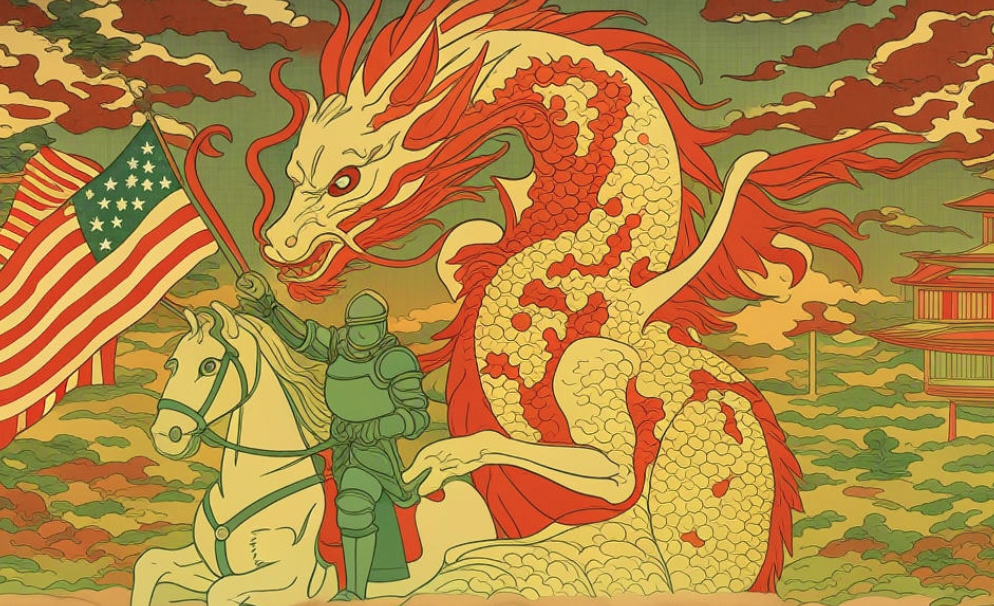
The dragon is not sleeping. It is dying, and the sound you hear is the rattling of its cage.