The statement that broke the news
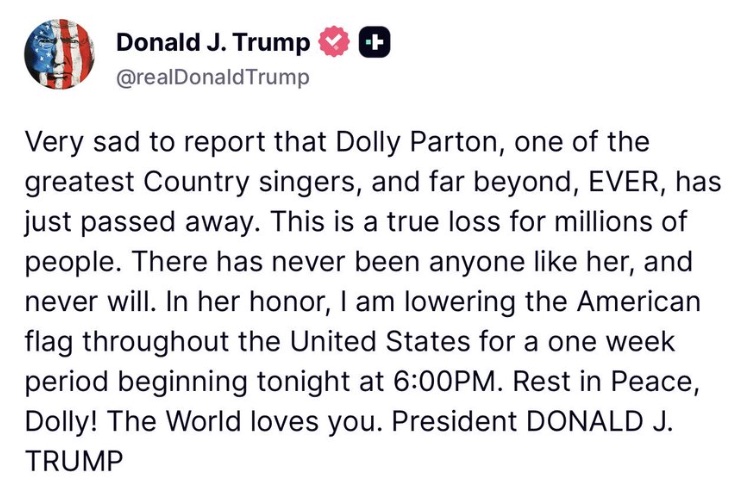
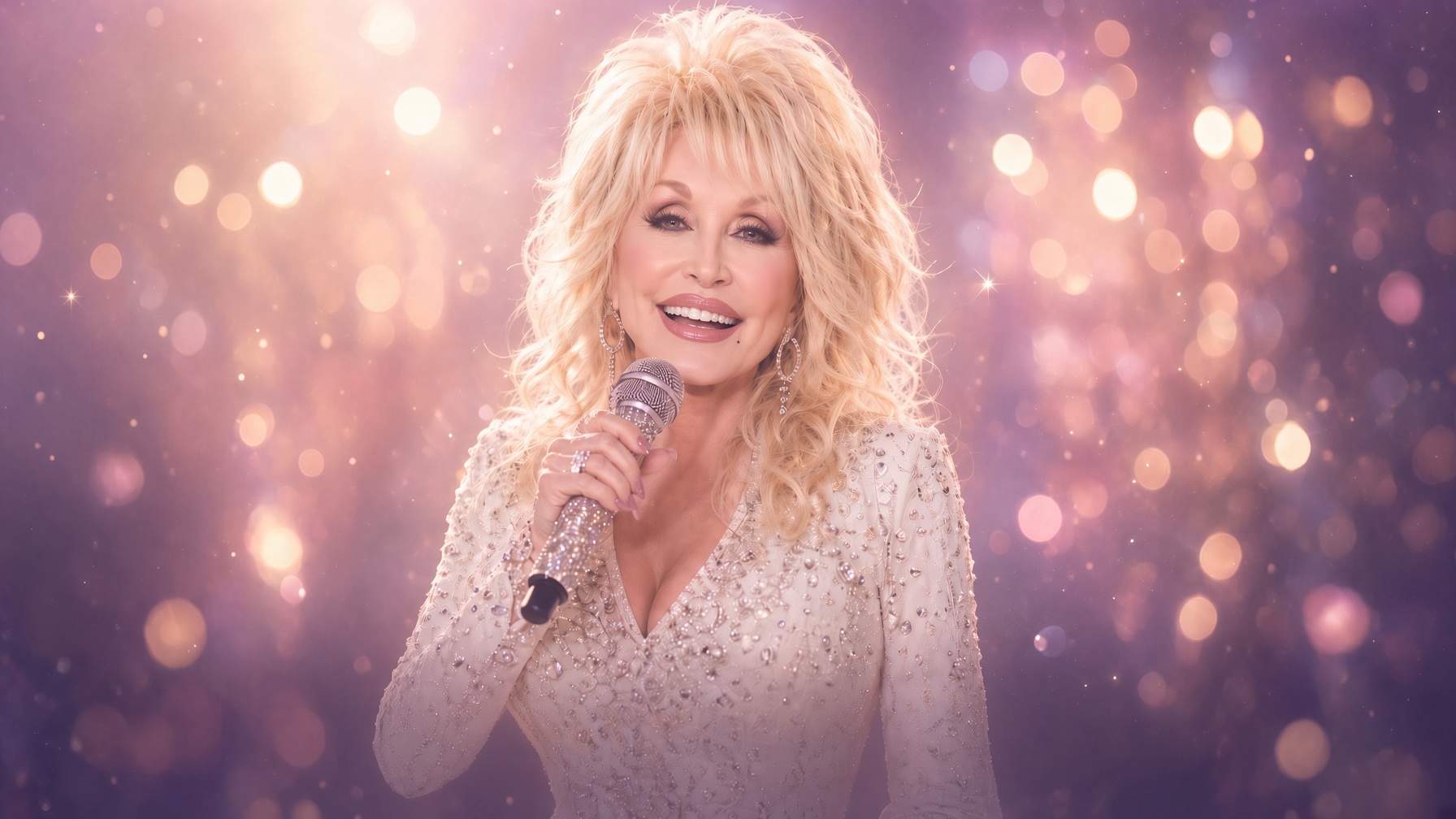
Dolly Parton died today, August 25, 2026, in Nashville, at 80. I have a Letterman-era memory of her spinning family stories — including one about a cousin she ran into at the state fair, working the sideshow in costume as the alligator girl. She didn't just carry presence. She carried kindness, and she was humble in ways most people can't begin to understand.
This knockout of a woman built an empire. She was loved by nearly everyone who ever sat across from her, knew of her, or simply had the luck of encountering her. She never pretended the girl from Locust Ridge had been replaced by anything grander than what her momma sewed.
Dolly Rebecca Parton was born January 19, 1946, the fourth of twelve children, in a one-room cabin on the banks of the Little Pigeon River in Sevier County, Tennessee. The family later moved to a small farm on Locust Ridge, in the foothills of the Great Smoky Mountains, and that is the place she spent the rest of her life describing. Her father, Robert Lee Parton, farmed tobacco and took construction work; he never learned to read. Her mother, Avie Lee Owens Parton, married at 15 and raised the family on almost nothing. The doctor who delivered Dolly was paid with a sack of cornmeal. They listened to the Grand Ole Opry on a battery radio.
The songs started at five. By ten she was singing on Knoxville television. At thirteen she played the Opry, introduced by Johnny Cash. The day after she graduated high school in 1964, she left for Nashville with a cardboard suitcase and a guitar. She married Carl Dean in 1966; they stayed married nearly fifty-nine years, until his death in March 2025. They never had children of their own. She became "Aunt Granny" to a small army of nieces and nephews instead.
The family stories were one of her finest instruments. God gave her the voice and the beauty too, but the stories were the thing she made herself. Large Appalachian clans, double first cousins, uncles who preached and uncles who drove, girls who ran a little wilder than the rest of the school. That was the well she drew from on late-night couches: specific, funny, unembarrassed. The alligator-girl story is how I always think of her — how it still made her giggle all those years later. She was beyond charming.
Porter Wagoner put her on his syndicated television show in 1967. She stayed seven years, became a star, and then had to leave. She wrote "I Will Always Love You" as a farewell to him — not as a romantic breakup — and sang it to him in his office the next morning. He cried, called it the best thing she had ever written, and then produced the record. It hit No. 1 on the country chart in 1974 and again in 1982.
Whitney Houston's 1992 version, from The Bodyguard, spent fourteen weeks at No. 1 on the pop chart. It made Dolly a fortune she would never have seen if she had given Colonel Tom Parker the half of the publishing he demanded before Elvis would record it. She refused him and cried all night over it. She later joked that Whitney's version made her enough money to buy Graceland — and, more quietly, she used some of it to buy an office building in a Black neighborhood of Nashville, which she called the house that Whitney built.
"Jolene" came around the same time — by her own telling, the same night. "Coat of Many Colors" came from a real coat her mother sewed from scraps. "9 to 5" came from the movie and became a working woman's anthem that still gets quoted by people who have never seen the film. She composed more than 3,000 songs. She sold more than 100 million records. She had 25 No. 1 country singles, a record she shares with Reba McEntire. She won eleven Grammys plus a Lifetime Achievement Award, ten CMA awards, and enough other hardware to fill a small museum.
The crossover came without abandoning country. Here You Come Again (1977) made her a pop star. Trio, with Emmylou Harris and Linda Ronstadt (1987), was exquisite. The Grass Is Blue (1999) went back to bluegrass and won another Grammy. In 2023, after the Rock Hall episode, she released Rockstar — covers with Paul McCartney, Ringo Starr, Stevie Nicks, Elton John — because she had said she would earn the honor if they insisted on giving it to her.
"I've done business with men who think I'm as silly as I look. By the time they realize I'm not, I've got the money and gone."
9 to 5 (1980), with Jane Fonda and Lily Tomlin, made her a movie star and earned her an Oscar nomination for the title song. Then The Best Little Whorehouse in Texas, Steel Magnolias, Rhinestone. She was never a conventional actress. She was a presence. People showed up to watch Dolly be Dolly.
In 1986 she bought into a failing amusement park in Pigeon Forge and turned it into Dollywood. It became one of the most successful theme parks in the country, a major employer in East Tennessee, and home to the largest sanctuary for non-releasable bald eagles in the world. She owned her publishing. She thought like a man in a business that expected her to look like a cartoon, and she said so out loud. Disney World has nothing on Dollywood.
Her father could not read. In 1995 she started the Imagination Library in Sevier County: one free, age-appropriate book a month, mailed to every enrolled child from birth to kindergarten. It now operates in the United States, Canada, the United Kingdom, Australia, and Ireland, and has gifted hundreds of millions of books, with millions more going out every month.
There were also scholarships, disaster relief, medical research, and a million dollars toward the Moderna vaccine, none of which she made a fuss about. You don't make a fuss when you're from Locust Ridge, especially when destined for greatness. The Motion Picture Academy awarded her the Jean Hersholt Humanitarian Award — an honorary Oscar — in 2025.
Six days before she died, the Academy of Country Music awarded her its Poet's Award at the ACM Honors in Nashville. She was too sick to travel and accepted by video. Carly Pearce, Carter Faith, and Kaitlin Butts sang "9 to 5" for her in the room. In the taped message she said that she had been able to do a lot of things in her life, but that songwriting had always been the most important part of who she was — every dream she ever had started with a song. It was the last honor she lived to accept.
In 2022 the Rock & Roll Hall of Fame nominated her, and she asked to withdraw. She said she didn't feel she had earned the right, and didn't want votes split on her account; she hoped they might consider her again if she was ever worthy. They inducted her anyway. She accepted with grace, and then went and made the rock album she had promised.
That is the refusal you remember. Not false modesty — a woman who took categories seriously and didn't want a seat that belonged to someone who had lived inside the form. She turned down other honors the same way: a statue on the Tennessee Capitol grounds, because she didn't want to be put on a pedestal; Presidential Medals of Freedom. She would take the work. She was wary of the marble.
Her contribution was larger than she ever let herself claim. She did not invent country music, but she made it travel farther without sanding off the accent. She proved a woman could own her catalog, her image, her park, and her philanthropy all at once. She made humility look like strength instead of strategy. And she stayed recognizable: the same girl who left Locust Ridge, still telling stories on late-night television decades later, still writing like she was talking to one person in a kitchen.
The song she wrote to leave Porter Wagoner became the song the world sings when it can't say goodbye any other way. That feels about right, right now.
I wept while writing this. I want everyone to know that. Her purity will be missed like no other.
I will always love you.
We will always love you.