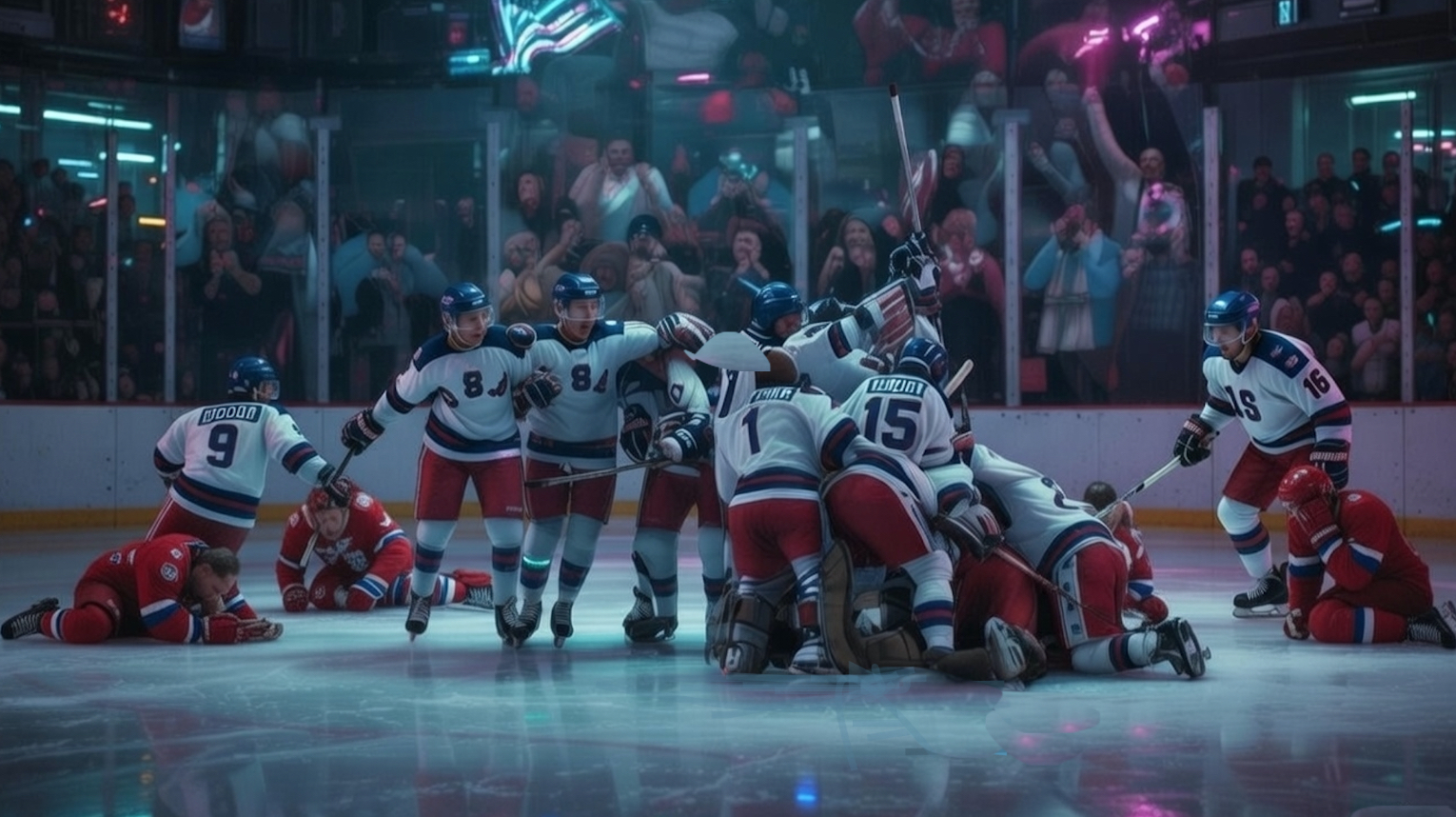
The bear had ruled the forest for so long that no one could remember a time when it did not. Forty-five years on, the sixty minutes at Lake Placid still read less like a hockey game than a verdict on two ways of being hard.
The bear had ruled the forest for so long that no one could remember a time when it did not. Eleven hundred pounds of muscle and memory, fed on state grain and winter-long drills, it moved with the slow certainty of something that had never been hungry. Its cubs were taken early, raised in barracks, taught that pain was a privilege and losing was treason.
The bear did not play hockey; it performed inevitability. When it lumbered onto the ice in Lake Placid on February 22, 1980, the only question in the building was how many goals it would score before growing bored.
Across the rink stood a pack of wolves. Twenty American kids, average age twenty-one, most of them still growing into their shoulder pads. They had been thrown together only seven months earlier by a coach who hated losing more than he loved breathing. Herb Brooks had skated them until they vomited, screamed at them until they cried, then made them skate some more. He told them they were not good enough to win on talent, so they would have to win on conditioning, on will, on something the bear had forgotten existed.
They Were Not Amateurs
That word is a lie we keep telling ourselves to make the miracle feel safer. Amateurs play for fun on Tuesday nights. These boys had survived the same meat grinder every Canadian and Russian kid survives: house league cuts at nine, AAA tryouts at twelve, major-junior or college scholarships at sixteen.
By the time they laced up for the Olympics they had already buried a thousand dreams that belonged to other people. They were rookies only in the sense that none had ever signed an NHL contract, none had played a minute for pay. In every way that matters on ice, they were predators who simply hadn’t been fed yet.
“They were rookies only in the sense that none had ever signed an NHL contract. In every way that matters on ice, they were predators who simply hadn’t been fed yet.”
The game itself is carved into the American soul the way certain Psalms are carved into older civilizations. Still, walk through it once more, slowly, the way you walk through a battlefield at dusk.
Sixty Minutes, Goal by Goal
Vladimir Krutov tips Kasatonov’s point shot past Craig. The strings-and-pulleys hockey begins.
Buzz Schneider, a kid from Babbitt, Minnesota, beats Vladislav Tretiak — the greatest goaltender who ever lived — from the wing.
Sergei Makarov restores order on a play so pretty it feels insulting. The wolves look small, frantic.
Mark Johnson bangs in a rebound with one second on the clock. The horn sounds, the red light still flashing, and the Soviets skate to their room in stunned silence. Somewhere in Moscow a general spills his tea. Viktor Tikhonov stares at the ice as though it has personally betrayed him, then does the unthinkable and pulls Tretiak for backup Vladimir Myshkin. The first crack in the myth.
Aleksandr Maltsev scores shorthanded. The Soviets outshoot the Americans 12–2 in the period and lead anyway by a single goal.
Johnson again, with the U.S. killing yet another penalty, roofing it over Myshkin’s glove. The building detonates.
Dave Silk forces a turnover and Mike Eruzione — captain, son of an Everett, Massachusetts sewer worker — takes a Pavelich pass at the top of the circle and wires it top corner. Ten minutes to guard a one-goal lead against the greatest team in history.
The clock becomes a prayer. Al Michaels counts it down like a man watching his own heart beat:
ABC Sports
Tape delay, 8:00 p.m. ET
Final score: United States 4, Soviet Union 3.
The Arithmetic of an Upset
The Americans were outshot in every period and won anyway. Craig faced 39 and stopped 36.
Six golds in seven Games. Lake Placid is the outlier that everyone remembers.
Beating the Soviets won nothing. The gold came two days later against Finland — down 2–1 after two periods before scoring three in the third.
Nine Things About That Night
Almost nobody watched it live. ABC aired the game on tape delay at 8:00 p.m. Eastern, hours after the horn.
Thirteen days earlier, the same Soviet team beat the same Americans 10–3 in an exhibition at Madison Square Garden.
Sports Illustrated ran the cover photograph with no headline and no caption. There was nothing to explain.
Tikhonov called pulling Tretiak after the first period the biggest mistake of his coaching life.
Ken Morrow left Lake Placid with a gold medal and won the Stanley Cup with the Islanders three months later — the only man to do both in one year.
Eruzione never played another competitive game. He retired at twenty-five with the biggest goal in American hockey.
Twelve of the twenty Americans came from Minnesota; nine had played for Brooks at the University of Minnesota.
Mark Johnson’s father, Bob, coached Wisconsin and later the Penguins. Hockey ran in the family before the miracle did.
In 1999, Sports Illustrated named it the top sports moment of the twentieth century. Not the top hockey moment. The top moment.
And that is the lesson, the one that still matters when empires rot and new empires rise.
Two Kinds of Hard
The bear was hard. Harder than any team before or since. But hardness forged in fear eventually atrophies into caution. When your entire life has been a command performance, the moment you sense the music might stop, you tighten. You play not to lose.
The wolves were hard too, but hardness born of hunger is different. They had no state dinners waiting for them in Washington if they lost, no dachas on the Black Sea if they won. They had only the ice in front of them and the choice to leave everything on it. Freedom gave them nothing, and therefore everything. They were free to fail so catastrophically that no one would ever let them forget it, and that freedom lit a fire colder systems can never match.
“The bear does not roar in defeat. It simply turns and lumbers off the ice… The wolves leap on each other like children who have discovered they can fly.”
Where Are They Now
Herb Brooks
Coached four NHL clubs and took the U.S. to silver in 2002. Killed in a single-car crash outside Minneapolis in August 2003, weeks before the film about him began shooting.
Mike Eruzione
Walked away from the game immediately. Spent three decades at Boston University in development and remains one of the most-booked speakers in American sport.
Jim Craig
Thirty NHL games over three seasons, then out. Built a second career in sales and corporate speaking in Massachusetts; auctioned his 1980 gear in 2018.
Mark Johnson
The best pro career of the group — 669 NHL games. Has coached Wisconsin women’s hockey since 2002 to a stack of national titles, plus Olympic silver in 2010.
Ken Morrow
Four straight Stanley Cups with the Islanders, then a long run in their front office as a scouting executive. Still with the organization.
Neal Broten
1,099 NHL games and a Stanley Cup with New Jersey in 1995 — the rare Lake Placid kid who kept going. Back home in rural Minnesota.
Vladislav Tretiak
Retired at thirty-two, first Soviet-trained player in the Hockey Hall of Fame, later president of the Russian ice hockey federation and a member of the Duma.
Al Michaels
Had called exactly one hockey game before Lake Placid. Went on to four decades of prime-time football and the most replayed eleven seconds in broadcasting.
The
Verdict
A people who must be ordered to greatness will one day refuse the order. A people who are free to be great, or to fail trying, sometimes remind the world what greatness actually looks like.
That night in Lake Placid the hungry wolves did not just beat a sleeping bear. They reminded every one of us that when you have something worth fighting for — something you chose instead of something you were told to choose — you can still pull the heavens down onto a sheet of frozen water in upstate New York and make the whole world believe again.
It never was.”