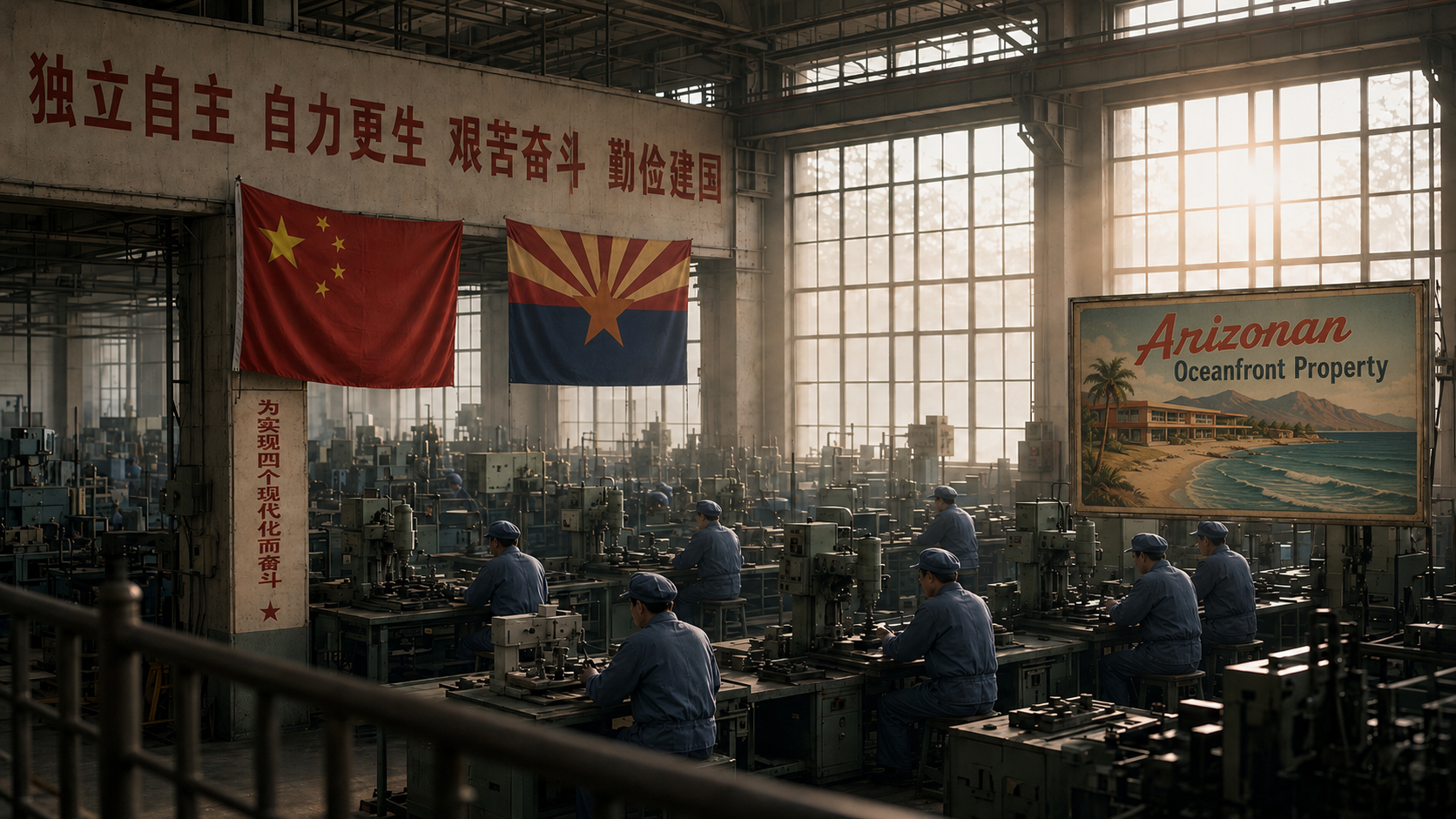
Chinese Labor's Arizonan Oceanfront Property Empire
Apple needed 8,700 engineers to watch 200,000 workers — and they weren't standing at the line. They were spread across the whole country, babysitting parts.
“If a company here wants to make a chair, it costs fifty dollars in labor. If a company in China makes the same chair, the labor costs four cents. Four cents! You can’t compete with four-cent labor.”
Michael Scott. The Office, November 2010.
“In China, workers get two days off a month. Here, they want two days off a week. They want eight-hour shifts, overtime pay, and constant breaks. That is why production moves to China.”
Fuyao senior management. American Factory, 2019. Academy Award for Best Documentary Feature. Financed by Participant Media, founded to change society, released with three hundred partner organizations behind it.
“The reason that all these trade agreements and outsourcing and manufacturing is because they’ll work for nothing. China, they get child labor, they got no labor laws… how much would you pay for an iPhone if it was made in America? $5,000, $1,000? … The reality is we’re better at services, we’re better at technology, better at STEM. That’s what we’re better at. And let the people that will work for cheap … work for basically nothing.”
PBD Podcast, Episode 415, 28 May 2024.
American Factory follows the aftermath of the 2008 GM assembly plant closure in Moraine, Ohio. In 2014 the Chinese industrialist Cao Dewang, chairman of Fuyao Glass, bought the abandoned plant to manufacture automotive glass for American automakers, hiring thousands of local workers alongside hundreds of Chinese workers brought from Fujian to oversee setup and operations. What begins as an optimistic cross-cultural venture devolves into a breakdown over labor practices, efficiency, unionization, safety standards, and fundamental differences in output expectations. Directed by Steven Bognar and Julia Reichert. Released by Higher Ground Productions.
The rest of the comparison is preserved in the words of Fuyao’s own management.
“When we began operations in the US, we thought it would be easy… But American workers are paid vastly more while producing significantly less per hour.”
“American workers are too slow. They have fat fingers. We have to keep adjusting the machines because they can’t keep up with the pace.”
And as a United Auto Workers campaign gathered, Chairman Cao:
“We need to replace them with machines. Automation is faster, cheaper, and doesn’t complain about wages or unions.”
Laughs as social change might be a step above cringe woke movies as social change, though both offer mendacity as propaganda.
The claim is false. Not exaggerated, not incomplete — false in its mechanism, false in its direction, and false in a way that was demonstrable in 2010 and is demonstrable now.
What follows is the case, and it begins a long way from Ohio.
What Is the Cost of Chinese Labor?
Chairman Mao, in 1958, decided that steel was a quantity. Set the target high enough, put enough hands on it, and the tonnage appears.
Backyard furnaces went up across the countryside. Woks, hinges, tools and farm implements went into them. What came out was slag — brittle pig iron, useless as steel. The harvest stood in the fields because the people who grew it were tending furnaces. Production figures moved up the chain inflated, because reporting a shortfall got you struggled against, and the state requisitioned grain against numbers that did not exist. It took the seed grain too.
Estimates of the dead run from fifteen to forty-five million.
Famine is what the cheapest labor on earth produces without engineers, without process, without anybody who can tell good iron from bad. Not cheap steel. No steel, and a famine. The largest experiment ever conducted in the proposition that quantity of labor substitutes for a system, run at continental scale, and settled permanently.
Michael Scott’s four-cent chair does not exist. It has never existed. Four-cent labor with nothing behind it produces a chair that cannot be sat on, and China spent two decades proving it in the most expensive way available.
March 1969. Eleven years after the furnaces, Chinese and Soviet troops fought on Zhenbao Island in the frozen Ussuri. Through that summer Moscow hinted repeatedly that it might strike China’s nascent nuclear facilities. On 18 August a Soviet embassy official in Washington asked an American diplomat what the reaction would be to an attack on those facilities. The reaction was negative. Moscow sounded out its Warsaw Pact allies as well. On 27 August the Director of Central Intelligence, Richard Helms, told the press that the Soviets had been canvassing foreign governments about a possible preemptive strike.
Kosygin met Zhou at the Beijing airport on 11 September and the crisis broke, but China had learned what it was standing next to, and turned west.
February 1972. Nixon in China. Not the opera. The President landed in Beijing and the photography completed. Note what that was and was not. It was triangular diplomacy — split the bloc, gain leverage on Moscow, find an exit from Vietnam. It was not a trade mission. Nobody opened a market. A door was opened, for reasons that had nothing to do with commerce.
After the photographs, there was a long pause. Mao died in 1976. The Third Plenum issued gaige kaifang in December 1978. Normalization came in 1979, the first four Special Economic Zones in 1980, Deng’s Southern Tour in 1992, WTO accession in 2001. Seven years from the photographs to the policy, twenty to serious volume, thirty to the flood.
In 1978 roughly seventy percent of China’s labor force remained in agriculture. Poverty was extreme by any international measure and average per capita income was among the world’s lowest. Living standards had already collapsed 20.3 percent between 1958 and 1962, then fallen another 9.6 percent from 1966 to 1968.
The cheapest labor in the world. Hundreds of millions of people at the floor of human subsistence. Available, unpriced, and nobody wanted it. Not in 1962. Not in 1972, when the door stood open and the cameras were rolling. Not for a decade after that.
Capital did not arrive when the labor got cheap. The labor had always been cheap. Capital arrived when the apparatus arrived — the zones, the land, the ports, the guaranteed terms, a state that could deliver. And by the time it arrived in volume, wages were already climbing.
There was nothing to move to
This disposes of the other half of the folk story before we reach Ohio. We shipped the factories over implies American plants were disassembled and set down in Guangdong. Look at the ground. Shenzhen was a border county. There were no factories there to ship to, no supplier base, no port at that scale, no grid, no roads.
The capacity that ended up in China had never existed anywhere: Zhengzhou at half a million units a day is not a relocated Ohio plant, and nothing in Ohio ever did that.
Two separate things happened, and the word shipped welds them into one. Plants here closed, for reasons that were also here. American companies built new capacity there, as we will see.
You cannot argue with a relocation; it has the finality of weather. You can argue with a closure decision and a construction project, because both were made by people.
Marbles
DUTCH’ ROBBINS NOW MARBLES CHAMPION; Springfield (Mass.) Boy Defeats Kentucky Runner-Up 6 Games to 4. BIG CROWD CHEERS RIVALS Prizes, Including Gold Watch, Heaped on Winner — 63 Other Contestants Receive Awards.
Six games to four. A crowd. A gold watch. Sixty-three other boys who came and were beaten and got something anyway. Whatever else that is, it is a result that carries information about the boy who produced it.
W. Edwards Deming taught with a bowl of marbles — mostly one color, a few not. People drew, and they were praised or punished according to whatever color came up in their hand. No one in the room controlled the outcome. Probability did.
He ran the exercise to destroy performance ranking. A man who watched him do it at Stern took the lesson the other way: that is how people are promoted in manufacturing. The one who draws the off-color marble rises, and afterward the industry treats the ascent as evidence about the man — his instincts, his touch, the one who turns plants around. He will believe it himself. No one experiences his own draw as a draw.
So the near-randomization of promotions runs the whole height of the manufacturing enterprise. The man at the bottom receives the diagnosis and the man at the top receives the credit, and neither result carries information about either of them.
The missing variables
The missing variables in the Fuyao comparison are not marginal. These are not atmospheric conditions surrounding productivity; they are among its causes.
The estimate in Out of the Crisis that roughly 94 percent of troubles belonged to the system rather than to special causes was valuable because it sent the investigator toward the people capable of designing recurrent conditions, instead of allowing management to explain recurrent outcomes through the allegedly defective character of thousands of workers.
An employee can certainly be lazy, careless or incompetent, but when an organization discovers the same problem across an entire workforce, the statistical miracle required to blame individual character should make the explanation embarrassing.
W. Edwards Deming was American. On 24 June 1980, NBC aired If Japan Can… Why Can’t We? and put a nearly eighty-year-old man on American television telling executives to their faces that the decline was a failure of management, not labor. Japan listened first.
Thirty years later the same network aired Michael Scott explaining that the problem was benefits and weekends, and thirty-nine years after that a film financed by a company organized around social change preserved a supervisor’s opinion that the problem was fat fingers.
IMG_10 — Deming, on American television in June 1980, telling American managers that the workforce is six percent of the problem. The room is empty.
Twelve hours looks like industry
The moral direction of the Fuyao comparison changes radically once hours and living conditions are restored to it. The Chinese employees were working under a labor regime of much longer shifts, far fewer days off and, for some, prolonged separation from family, while the American employees expected eight-hour days, weekends, safety protections and a life in which the employer’s authority ended somewhere before the front door.
Because regimentation photographs beautifully, the comparison acquires an intuitive force before anyone has performed the industrial calculation. A man moving rapidly for twelve hours looks more industrious than a man working eight. Rows of workers moving together look disciplined. An employee willing to surrender most of a month to the factory looks committed. None of this tells us how much acceptable output the factory receives from an hour of labor.
American industry has already run the experiment at a scale sufficient to dispose of the national-character theory. During the Second World War American manufacturers absorbed designs they had not originated, redesigned production around them, standardized components, trained enormous new workforces and turned complicated machines into repeatable output at extraordinary scale. Ford did not invent the B-24 Liberator, yet Willow Run eventually produced the aircraft at a rate approaching one an hour. Bantam’s original light reconnaissance vehicle did not remain a sacred artifact of its designer but entered a process involving Willys and Ford through which the Jeep became standardized and manufacturable by the hundreds of thousands.
The accomplishment was not that an American pair of hands moved faster than a Chinese pair might have moved. The accomplishment was that management, engineering, capital and labor had been assembled into systems capable of multiplying what ordinary hands could accomplish.
A worker trapped in a poorly designed system may exhaust himself and still produce little of value. The same worker, placed in a system thoughtfully arranged, can work almost at ease and turn out twice the acceptable product.
A factory that runs only by continuous extraordinary effort has simply transformed managerial shortcomings into a demand for daily heroism. When the line holds together solely because people must stay forever alert, management has not found a superior workforce. It has merely failed to put enough intelligence into the system itself.
The same principle applies to sourcing abroad. A quotation that appears cheap before supplier audits, resident engineering, incoming inspection, corrective-action programs, material verification, travel, rejected lots, rework and constant supervision have been counted is not yet a production cost.
If a supplier must be watched like a hawk, the hawk belongs in the calculation.
iSchool
The vocational school in China is Apple.
For the original iPhone, Apple’s own analysts estimated they needed 8,700 industrial engineers to oversee 200,000 assembly-line workers. They projected nine months to find them in the United States. In China it took fifteen days.
Eighty-seven hundred engineers to two hundred thousand workers is one engineer for every twenty-three workers. The story always files this under China has more engineers , a supply anecdote. It is a confession about what production actually is. You cannot get a consistent product out of two hundred thousand human beings without a standing army watching, correcting, retraining and re-specifying every hour of every shift.
Nobody in this debate argues about the 8,700. That is where the entire advantage lives.
IMG_04 — Eight thousand seven hundred engineers among two hundred thousand workers. The figures in dark coats are the product. The pattern is the argument.
Nor were they standing at the line
They were distributed along the entire chain — at the port, at the sub-tier vendor, at the machining shop, at incoming inspection, at every point where material changed hands between one company and the next.
Variation does not enter at the station, where a worker performs one motion under a fixture designed to permit only that motion. Variation enters at the seams, and a supply chain is mostly seams.
The resident engineer is not a supervisor in the labor-discipline sense. He is a systems integrator holding the joints together, and he is expensive, and he does not appear anywhere in the cost of goods sold.
IMG_05 — An American badge on a Chinese console. The apparatus was staffed at every tier of the chain, and a great deal of it was staffed by us.
Labor is a rounding error
An iPhone 15 Pro Max sells for one thousand one hundred and ninety-nine dollars; final assembly in China runs about twenty-one.
Take the assembly labor to zero — free workers, volunteer labor — and the price moves less than the sales tax. Nobody restructures a global supply chain and accepts seven thousand miles between the engineers and the line to save one and three quarters percent on a cost sheet.
The four-cent chair is not the mechanism. The four-cent chair was never the mechanism.
IMG_02 — The $21 beside the $1,199. Assembly is the last thing that happens to a phone, and the cheapest — which is exactly why it is the number everyone quotes.
The cost is real. It is on a different line.
The engineers, the resident supply-chain staff, the vendor quality teams, the tooling programs, the people flying between Cupertino and Guangdong for twenty-five years — almost none of that is in cost of goods sold. It is operating expense, and it never touches the per-unit number anyone quotes.
Cheap labor is not a fact about China. It is an artifact of where you stop counting.
IMG_06 — The legible top of the receipt is cost of goods sold. Everything printed below it was booked as overhead, and nobody reads that column.
We did not find the capability. We installed it.
Patrick McGee’s Apple in China (2025), built from more than two hundred interviews with former Apple executives and engineers and from internal documents, puts figures on it.
Apple-owned machinery sitting inside Chinese supplier factories by 2012 — more than Apple’s American buildings and retail stores combined.
Apple’s investment in China by 2015, excluding components.
The 2015 commitment, over five years, into one country — twice the cost of rebuilding postwar Europe.
Workers trained since 2008, on Apple’s own estimate — more than the entire labor force of California.
The largest industrial training program in modern history, an American corporation, mostly in Henan and Guangdong, across the same two decades in which American apprenticeship collapsed and domestic supplier relationships degenerated into reverse auctions. McGee’s summary of it is four words: the vocational school in China is Apple.
To boot, no supplier could be more than fifty percent dependent on Apple revenue — protection against a design change bankrupting a vendor overnight — which meant the firms Apple had trained, tooled and staffed were contractually obliged to go sell that capability to somebody else. Somebody else was Huawei. Xiaomi. BYD. DJI.
The story says China possessed something America could not match. Americans built it. In Shenzhen, in Zhengzhou, in the Yangtze Delta, deliberately, at twice the cost of rebuilding postwar Europe — and it is now described as a natural endowment that American workers priced themselves out of.
You cannot outcompete a capability you paid to install.
IMG_07 — What crossed on ships was second-hand capacity. What crossed on planes was the capability — and it flew back and forth for twenty-five years.
Enclosure, not diligence
China Labor Watch found that more than half the roughly two hundred thousand peak-season workers at Foxconn’s Zhengzhou plant are seasonal dispatch staff — despite a Chinese law capping such staff at ten percent — on staggered payment schedules that withhold part of their wages specifically to deter them from quitting, without entitlement to paid sick leave, paid holiday or social insurance.
The dormitories and the canteens and the guards directing foot traffic are not benefits. They are throughput infrastructure. They exist so the line never stops, and they exist because the worker is a thirty-hour train ride from home and cannot leave until the season ends. And they are watched like an airborne hawk watches bunnies in a prairie.
They can leave. They do not, and will not, and the structure is built so that they do not. That is the actual difference between Moraine and Fujian, and Fuyao’s management stated it accurately without understanding that they were confessing rather than complaining.
Two days off a month is not diligence. It is enclosure. The American worker who wanted two days off a week was not slower; he was harder to store.
Sorry about the slum dormitory.
IMG_11 — Dispatch labour housed on site, above half a workforce the law caps at a tenth. Admiring the engineering does not require accepting this.
Participant Propaganda
Participant Productions built a remarkable catalogue. Remarkably globalist. Again and again the individual standing in front of the camera becomes the entrance to a system operating behind him.
The company’s own catalogue places these films together, and the similarity is not principally ideological but causal. Then, rebranded simply as Participant, it financed American Factory , and the American worker somehow became the end of the investigation.
The studio behind Spotlight and Green Book did not merely release the film and later discover that people wished to discuss it. The company says it brought workers, labor organizations, corporations and other groups together, toured the film nationally, and put it into the hands of more than three hundred partner organizations whose events reached nearly 150,000 people.
partner organizations handed the film
people reached at their events
Academy Award for Best Documentary Feature
Its own campaign page says the film elevated the conversation about the present and future of work in the United States. The same page introduces the American employees as unusually casual and chatty, identifies low productivity as a source of conflict, and places those traits within the film’s central collision between Chinese management and American labor.
A corporation announcing that it intends to change society has told us it wants a hand on the wheel.
IMG_19 — Three hundred partner organizations and an Academy Award. A company organized around social effects does not get to discover innocence when an effect becomes embarrassing.
Industrial defamation collapses the future
They know. They are cognizant. There is no naïve filmmaker here who wandered into a factory and accidentally produced a misleading comparison. If a film helps legislation the house favors, the film demonstrates the power of storytelling; if another film helps lodge a false causal account of American industrial decline in the public mind, storytelling cannot suddenly become a passive mirror whose audience alone is responsible for interpretation. The causal instrument cannot be advertised on the front end and disowned on the back.
The injury is larger than an insult to workers, because judgments about workers influence the systems built around them. If American labor is believed to be intrinsically too expensive, insufficiently disciplined and incapable of competing, investment in American labor begins to look irrational. Underinvestment then makes the workforce less competitive, suppliers lose volume, tooling ages, skills disperse, young engineers follow production abroad, apprenticeship networks collapse, and the resulting weakness returns years later as proof that the original judgment had been correct.
The description participates in creating the condition it claimed merely to describe. Defamation in this context erases work, removes it from those that toiled.
Manufacturing knowledge does not reside exclusively in patents, CAD files and instruction manuals. It resides among people who discover what happens when a drawing must become ten thousand identical objects: machinists who know which tolerance will become unstable after a tool warms, engineers who learn from defects, maintenance workers who know why a machine behaves differently on Tuesday afternoon, suppliers who discover how to make a material consistently, managers who learn which sequence produces flow, operators who solve problems too ordinary ever to become formal inventions.
Once these relationships are dispersed, a check cannot instantly purchase them back. A building can be erected quickly. An industrial culture cannot.
A spy who steals a nuclear secret commits an obvious betrayal, because he takes something valuable from the country that produced it. The theft itself acknowledges the value, and the scientists, laboratories, machine tools, suppliers and institutions capable of creating the next secret remain behind. A society persuaded that its own productive system is obsolete inflicts a stranger injury upon itself, because it begins dismantling the machinery from which future secrets would have come.
One theft removes fuel from the tank. The other supplies the owner with an economic argument for running the pumps dry.
The ballad of the gas pump
Apropos crude distilled, Jeff Skoll allegedly pumped gas. This is his claim, for he has many. His father made chemicals, any number of them more watchable in a sitting state, in a beaker for hours, than anything made by Participant Media, founded by Skoll, but now defunct.
Forbes supplies the opening image: he worked his way through university pumping gas. His father had owned an industrial-chemicals business before selling it to a partner after a cancer diagnosis; Jeff earned an electrical-engineering degree from the University of Toronto, tried his hand at business, went to Stanford for an MBA, joined eBay as its first full-time employee and president, became a billionaire at the IPO, and devoted the fortune to changing the world through philanthropy and stories.
It is a magnificent little American sentence, despite having happened in Canada. Nothing in it needs to be invented for the construction to perform its work. The gas pump arrives already equipped with moral significance. We know what we are supposed to learn before we know the station, the schedule, the wages, the duration of employment, or what proportion of tuition those wages actually covered. He worked at a gas station describes employment. Worked his way through university pumping gas supplies an economic origin story, and the story then holds that nothing which followed was given to him.
Real work normally produces lateral detail — a manager, coworkers, shifts, pay stubs, insults, weather, smells. Biography becomes curious when an anecdote survives principally in the exact form required to certify character while the ordinary world around it remains thin. Truth is overdetermined. Legend prefers the frontal view.
The next chapter does not become more substantial. After university Skoll started Micros on the Move, a computer-rental business whose enduring anecdote is that customers kept stealing the computers. The business was poorly chosen even before theft entered the account: by the late 1980s the personal computer was becoming a repository for a user’s files, configuration and software environment, all of which made a general consumer rental proposition awkward in ways that televisions, cars and tools were not. It appears in the biography not because it established Skoll as a formidable operator but because its failure can be converted into entrepreneurial apprenticeship.
His systems-engineering consulting business occupies even less space. Forbes calls it an attempt that did better than computer rentals but was not the success Skoll wanted, followed immediately by Skoll’s recollection that he realized he did not know what he was doing. Public biographies call the enterprise Skoll Engineering and variously describe consulting work, but the standard accounts offer almost none of the texture by which one ordinarily understands a consultancy: named projects, named clients, staff, revenue, contracts, systems designed, organizations materially changed.
The label consulting business does considerably more biographical labor than the publicly described work.
IMG_18 — The anecdote arrives already equipped with moral significance, and nothing around it does. That is how you tell a legend from a job.
Thirty million shares inside the phrase “first president”
Stanford follows, after which the legend accelerates so rapidly that later success begins to illuminate earlier events backward. Skoll received his MBA in 1995, worked briefly at Knight-Ridder on internet strategy, and knew Pierre Omidyar through mutual friends. Omidyar showed him the idea that became eBay; Skoll’s famous response, repeated by Skoll himself at Stanford, was Pierre, what a stupid idea.
The joke is useful now because history has supplied the punch line, but at the moment it occurred the recent MBA was being shown an internet marketplace by the programmer who had already built one and was watching strangers use it. Skoll’s initial contribution was not prophetic commercial vision. It was disbelief.
AuctionWeb did not wait for his enlightenment. Omidyar launched it in September 1995, and by February the traffic had grown enough that his internet provider raised his monthly charge from roughly thirty dollars to two hundred and fifty. He responded by charging sellers a percentage of successful transactions — five percent on sales under twenty-five dollars, two and a half above — and sellers mailed checks, cash, sometimes coins.
The business had achieved the single proof that business plans are forever trying to predict: strangers were voluntarily paying money for the thing Omidyar had already built.
Skoll began consulting for AuctionWeb in February 1996 and joined full-time in August. Adam Cohen describes Omidyar’s problem plainly: he believed he needed a business plan and did not think he could write one himself, so he thought of the Stanford MBA he had met through friends. AuctionWeb was not a distressed company requiring rescue, nor a pre-revenue concept seeking someone to discover a market. It was a crude, rapidly growing marketplace whose founder needed organizational help because the machine had begun working faster than the organization around it.
The later phrase Skoll wrote eBay’s business plan gives this a grandeur it does not deserve. An MBA should be able to write a business plan. The difficult work in business is not arranging five-year projections in a document but surviving the continuous humiliation imposed when customers, competitors, employees, costs and technology refuse to behave according to the document. Skoll would later boast that eBay reached the five-year numbers in his plan by the second year, which is pleasant for the author of the plan, although explosive growth beyond a forecast demonstrates at least as clearly that the market was stronger than the forecast.
The presidency requires a different explanation, because the title has been allowed to float backward from the mature eBay into the tiny AuctionWeb that existed when Skoll received it. In 1996 Omidyar was assigning titles inside a company that had only recently stopped operating from his home; when Skoll joined, they moved temporarily into the Los Altos Hills group house Skoll shared with former Stanford classmates. The distance between this and the corporation that would later employ thousands is the difference between a boat being built onshore and an aircraft carrier.
a month. Thirty thousand a year — the pay of a tiny startup, because that is what the company was.
shares, for sixty-eight thousand dollars — lent to him in full by the company, full recourse, six percent. The filing later grouped Omidyar and Skoll together as the Founders.
He did not arrive bearing the capital that explains his founder-scale ownership; eBay financed his acquisition of it. This is the hole in the ballad. The gas pump does not fill it. Micros on the Move does not fill it. A lightly documented consulting business does not fill it. A Stanford MBA does not fill it. Brief work at Knight-Ridder does not fill it, and telling Omidyar that his already functioning marketplace was a stupid idea certainly does not fill it.
Friendship and trust can explain why a founder hires someone he knows; tiny companies have always hired friends and classmates. They do not by themselves explain why a man who had not built the product, discovered the market, supplied the capital or recognized the opportunity at first sight received economics sufficiently large that the mature corporate history would eventually describe him as a founder.
Nothing sinister is required to make the gap interesting. The gap is interesting because the biography treats it as though no gap exists. Thirty million shares disappear inside the phrase first president .
And the company itself developed a taste for narrative compression early enough to make the method familiar. The Pez-dispenser legend — invented as a public-relations story rather than the actual reason Omidyar created AuctionWeb — is the comic extreme of it. A true company acquired a false origin because the false origin was warmer, simpler and easier to print. The episode demonstrates how little friction separates commercial history from useful mythology once a story performs better than the truth.
Skoll left eBay rich enough to turn this lesson into an institution, and his own account is unusually candid about the continuity. He says that as a teenager he wanted to write stories about problems facing the world but decided storytelling would not be the best way to make a living, so he pursued entrepreneurship first. eBay gave him resources on a scale he had never imagined, after which he returned to the original ambition and created Participant.
The ballad thus ends extraordinarily far from the pump. A biographical anecdote certifies the humility of the young man; failed businesses become entrepreneurial schooling; a short conventional résumé becomes the runway to a founder-scale stake in one of the great accidental growth machines of the early internet; the stake becomes billions; the billions become philanthropic authority; philanthropic authority becomes the authority to select social problems; the selected problems become movies; the movies become organized campaigns; the campaigns become measured social impact; and social impact is finally presented as its own justification.
The machinery is propaganda in the original, uncluttered sense of the word: organized propagation intended to alter attitudes and behavior. The social impact production house did not hide this function. It celebrated it. The quality was never the point. The function is complacency, distributed, and it arrives finished in the mouth of a man who has never read a book or run a business: cheap Chinese shit, well, the labor’s cheap.
Not social change. Changed social.
Tempest at Woodside
A winter tempest was blasting Northern California on 17 February 2011. Hail hammered the decks in Daly City and Livermore, snow clung to the trees around Lick Observatory on Mount Hamilton, and flood watches stretched north of the city. Into that weather, up the hill to the home of John and Ann Doerr in Woodside, came the President of the United States. A dozen sat at the table: Zuckerberg to his right, Jobs to his left, and Schmidt, Ellison, Chambers, Hastings, Costolo, Bartz and Levinson around them.
Exactly one person at that table ran an operation that physically produced a hundred million objects a year, and he had eight months to live.
Jobs had proposed six or seven guests; Jarrett and the other aides expanded it past twenty with GE’s Jeffrey Immelt in the lead — and by 2011 GE was substantially a finance company wearing an industrial logo. Jobs emailed Jarrett that the list was bloated and he had no intention of coming. He was talked back in.
Jobs was frail. He had asked for this dinner himself, having met Obama alone at an airport hotel the previous fall, told him flatly he was headed for a one-term presidency, and offered to assemble the CEOs.
When his turn came
He said that Apple had 700,000 factory workers in China because it needed 30,000 engineers on site to support them, and that you could not hire that many in America. Then the part nobody quotes: these factory engineers did not have to be PhDs or geniuses. They needed basic engineering skills for manufacturing. Tech schools, community colleges or trade schools could train them.
“If you could educate these engineers, we could move more manufacturing plants here.”
Testify.
Delivered in 2011 by the most credible manufacturer in America, on the record, to the head of state. The exact inverse of Fuyao, eight years later. Not the wage. The missing technical layer. Jobs priced the fix at community-college tuition and put it in a conditional: do this, and we come back.
IMG_16 — One manufacturer at a table convened on manufacturing competitiveness. The asks around him were a tax break and visas for his own hiring.
The instrument
He made a second ask that night: that any foreign student earning an engineering degree at an American university should automatically be offered a green card. Obama’s response was that the change would have to ride on the DREAM Act, and Republicans had blocked it. Isaacson’s summary of Jobs’s reaction is one line — he found it an annoying example of how politics can lead to paralysis.
“The president is very smart, but he kept explaining to us reasons why things can’t get done. It infuriates me.”
A smart man builds, or he names the real obstacle and builds something else. Explanation is what you offer when you cannot build. Jobs had watched both kinds of men for thirty years and knew the difference. And he says it to a biographer, which puts it on the permanent record wearing a compliment.
DACA is a political workaround that converts unlawful childhood presence into protected, work-authorized status without Congress ever having to pass a law. It rewards the original violation by the adults who brought the children, creates a standing incentive for more of the same, and then layers temporary legal work rights onto a population that competes directly in segments of the labor market where many Americans already struggle.
The academic defense that there is no clear depression of native wages is a statistical average that ignores concentrated losses, treats adjustment by natives as if it were costless, and systematically excludes the cultural and civic diversion that accompanies large-scale non-assimilated inflows. Those studies often work backwards from a preferred conclusion, selecting measures and frames that keep the hard costs off the ledger.
Meanwhile the fiscal burden of schooling, emergency medical care, and local infrastructure falls heavily on states and localities, while the workers themselves operate under a wage discount that undercuts the bargaining power of citizens in the same jobs. American workers receive no parallel preference or pathway; they are simply told the data shows no average harm and that any resentment is suspect.
The result is a privileged limbo for one group created by unlawful entry, paid for in diluted opportunity, fiscal transfers, and eroded social trust by the citizens who never broke the law. Rightfully, Republicans helped the country dodge the DACA noose.
A new visa category required a statute. Congress had already defeated the DREAM Act. The answer was true.
Trade schools required none. The federal workforce money already existed inside the executive branch — no sixty votes, no immigration bill.
Nobody refused anything that night. A true answer to the small ask was allowed to stand in for the large one, and the subject never returned.
Eighteen months later the same administration produced DACA anyway — work authorization for a class of non-citizens, created by executive memorandum, without a vote, in a form the legislature had already declined to pass. The core distinction is temporary discretion versus permanent statutory status, and it is a real one: DACA conferred no green card, no path, nothing Congress had not withheld. But it establishes what the office could reach. The instrument said statute, therefore Republicans . Eighteen months on, in the adjacent policy area, that same authority moved without a statute and without Republicans.
If discretion could authorize work for hundreds of thousands, discretion could fund manufacturing engineers at community colleges. That required no sixty votes, no rider, and no bill. It required a President of the United States of America.
Naming the opposition is not the politics of that moment. It is an instrument, and instruments are disposable. He reached for the one that cost him nothing, and it worked: handed a question about national capability, he returned an answer about jurisdiction, and the room let him.
Something was bureaucratized. Nothing was built.
On 13 June 2011, four months after the dinner, the President traveled to Cree Inc. in Durham, North Carolina, met with his Council on Jobs and Competitiveness and announced a program to train 10,000 new American engineers a year: companies promoting STEM education, incentives for students to finish degrees, help for universities funding engineering programs, a doubling of summer internships. The council was chaired by Jeffrey Immelt.
The request was not refused. It was converted into the thing Washington already knew how to do — a third of the number, a different population, four-year degrees, and the word manufacturing gone from it.
Which is Christina Romer’s doctrine in program form, and she would not publish it for another year: writing in the New York Times , Obama’s own former chair of the Council of Economic Advisers asked why government should focus on manufacturing to create good jobs at all, when it could instead make it easier for workers to get the education for high-skilled jobs in any field. Education, not manufacturing.
What survived instead
Four words. Asked what it would take to make iPhones in America, Jobs said:
“Those jobs aren’t coming back.”
That went around the world and never stopped — the single most-cited authority for the inevitability thesis, quoted for fifteen years as proof that offshoring was gravity. Obama was still saying versions of it in 2016. The conditional clause had been amputated. A man described a fixable bottleneck and the culture extracted an epitaph from it.
Jobs was naive about exactly one thing. He thought he was having a conversation about engineers. The instant he said foreign students , his manufacturing-capacity request stopped being about manufacturing and became an immigration bill, and it died as one.
MathBook Pro
Wage cost genuinely mattered in the first wave, roughly 1990 to 2005, and in truly labor-intensive sectors — apparel, footwear, furniture, toys, hand assembly. There the gap really was the story. It stopped being the story around 2005, while offshoring accelerated for twenty more years. The China Shock work by Autor, Dorn and Hanson is real: import competition did measurable, lasting damage to specific American regions. Hundreds of millions of people left extreme poverty, which is not a footnote, and any account treating this as pure loss is telling its own lie. And some of what China built is worth refusing to copy — suppressed labor organizing, environmental costs paid in lungs and rivers, and the dispatch-worker regime described above.
Chinese manufacturing compensation ran roughly sixty to eighty cents an hour in the early 2000s. It now runs about $6.70 fully loaded, and closer to $9.70 at the foreign-invested and joint-venture plants where multinationals actually produce. Eight to tenfold. Over the same years China went from about six percent of global manufacturing value added to roughly twenty-eight or thirty percent.
Wages up tenfold, share up fivefold. If cheapness were the mechanism, China should have been hollowed out by 2012, beaten by whoever was poorer that year. It consolidated while getting expensive.
Cheaper places existed and did not win. Vietnam’s average wage runs about a fifth of China’s. Bangladesh and Cambodia and Ethiopia have been cheaper for twenty-five straight years, on the same planet, at the same freight rates, with no tariff penalty. They took apparel and footwear and low-end assembly, which is exactly what the wage theory explains and exactly its limit. And Foxconn’s Indian plants reportedly pay about eighteen percent more than Zhengzhou. Apple diversified toward a place that costs more.
One engineer to twenty-three workers is a ratio of control as much as of instruction. A high-trust, high-skill workforce needs less watching, not more — which is roughly the German answer, and Germany pays more than the United States for manufacturing labor while running a manufacturing surplus. Switzerland pays more still. So does Norway.
If high wages killed factories, Baden-Württemberg would look like Youngstown. Those are different systems, and only one of them is worth importing wholesale.
“Mendacity is a system that we live in.” Brick Pollitt — Cat on a Hot Tin Roof
China has cheap labor survived because it performed a task more politically useful than calculation. It removed choice. A plant was not inadequately modernized; production moved. Capital was not allocated according to incentives established by actual people; markets changed. Governments did not adopt policies with beneficiaries and victims; globalization happened. Management did not fail to organize American labor competitively; American labor became too expensive.
With every passive construction the people who possessed the greatest authority over the system receded, until the worker remained beside the machine, visible enough to be blamed for the consequences of decisions he did not make.
The American worker’s wages then became evidence against him, followed by his weekends, his safety requirements, his reluctance to work twelve hours, his expectation that a family should see him with some regularity, and his stubborn insistence upon living somewhere other than a dormitory controlled by the employer. A century of industrial improvement could thereby be transformed into a century of accumulated weakness.
The worker was no longer expensive because the society around him had become prosperous; prosperity itself became evidence that he lacked the seriousness of people compelled to surrender more of their lives to production.
Legal treason is properly narrow. Civic betrayal is not. A democratic population can be betrayed by explanations that deprive it of the knowledge necessary to identify its own choices, particularly when those explanations translate decisions made by powerful institutions into defects attributed to people who exercised almost none of the relevant power. The worker did not determine the capital budget, negotiate the trade regime, select the technology, design the line, decide where engineering would be located, or determine whether the factory would be improved or abandoned. He can still be made to carry the verdict after everyone who made those decisions has disappeared into the vocabulary of markets.
That disappearance manufactures complacency. A citizen does not have to celebrate the loss of an industry once he believes the loss could not have been prevented. He can regret the closed factory while accepting the explanation that closed it; he can watch a supplier network dissolve while regarding resistance as economically primitive; he can pity the unemployed worker while believing that the worker’s wages and habits caused his own unemployment.
The most efficient propaganda does not demand enthusiasm for surrender. It makes surrender appear mature.
Eventually the entire mechanism for interpretation reaches its ideal form in a sentence spoken by someone who has never had to know anything about manufacturing: China has cheap labor. He does not know the capitalization of the competing plants, the relative automation, defect rates, subsidies, energy prices, currency effects, logistics, working hours, quality-control burden or productivity per hour. He does not need to know. The sentence has been culturally engineered to end the inquiry rather than begin it.
Michael Scott says it and we laugh, because a sitcom is allowed to hand a man a stupid opinion and let him wear it. Fuyao’s management says it and an Academy Award follows, because a company that had spent fifteen years teaching audiences to look behind the visible person chose, this once, to look no further than him.
The American worker disappears first from the factory and later from the explanation of what the factory once accomplished. Management’s work remains management when the outcome is good; when the outcome is bad, the worker becomes expensive. Capital receives the return while the labor force receives the diagnosis.
What the empty machined slots in the concrete actually cost is not jobs. A country that cannot make its own things has handed someone else a decision it cannot take back. That is not a downturn. It is a dependency, and a dependency stays invisible until the moment it is exercised.
The cheap-labor alibi does not exist to explain the past. It exists to foreclose the future — because if the cause was arithmetic, then losing the capacity was nobody’s fault and recovering it is impossible, and nothing remains but retraining and acceptance.
IMG_17 — Bolt holes in the concrete where the machines stood. Not a downturn — a dependency, and a dependency stays invisible until someone exercises it.
Tables Cost Money
Made in America once meant everything. It can mean that again.
The capacity was built from nothing, in a country that had been eating bark sixty years earlier, by people who understood that a factory is a machine made of engineers rather than a room full of so-called cheap labor.
I stood in a warehouse in Foshan. A working factory, employees moving everywhere. No tables. Work happened on the floor, on crates, in laps. I asked the owner why he did not simply buy tables.
He looked at me as if I were insane.
Tables cost money.
Not tables cost more than they return . Not we tried tables and the layout suffered . Tables cost money, the men were already there, and the men were already cheap. Why purchase the fixture when you can purchase the posture.
The plant Fuyao’s supervisor measured Ohio against was the one in Foshan. A man bent over a crate looks industrious. A man at a properly built station looks idle. One of them produces something more, much more.
Jeff Skoll’s biography and Participant Media meet at that point. Both depend upon arrangement. In the biography, a gas pump, a failed rental business, a thin consulting record, Stanford, a fortunate relationship and an astonishing equity grant are organized into the smooth ascent of a great entrepreneur, and the gaps disappear beneath authority supplied retrospectively by eBay’s success. At Participant, selected facts, selected people and selected causal relationships are organized into stories designed expressly to leave the theater and change public judgment.
Skoll did not merely become rich and then happen to finance movies. He used the fortune produced by one of the most extraordinary commercial contingencies of the internet era to build machinery for deciding which stories society needed to hear, and then making those stories socially consequential. The biography calls this changing the world. The company called it impact.
The American worker might reasonably call it something else.
I carried Out of the Crisis under my arm as an undergraduate and was stopped in hallways by professors who looked at it the way one looks at a relic. They revered the book. The country it was written for had already declined to read it.
IMG_20 — Why purchase the fixture when you can purchase the posture. The plant Ohio was measured against was this one.
Ford did not design the B-24 Liberator. Consolidated Aircraft did. Ford was handed another company’s drawings, built Willow Run around them, broke the airplane into stampable and jiggable pieces, trained a workforce that had never seen an aircraft, and eventually produced a four-engine heavy bomber at a rate approaching one an hour.
Bantam designed the light reconnaissance vehicle and did not build most of them. The design went to Willys and to Ford, was standardized into something manufacturable, and came off the lines by the hundreds of thousands as the Jeep. Nobody protected the original. Quantity was the point, because men were dying for want of it.
Someone else’s aircraft. Someone else’s car. American plants, American management, American engineering, and callused American hands — backed by a production system that could take a design it had not invented and stamp out a hundred thousand identical machines fast enough to decide a war.
That was optimized productivity. Not cheap labor. Not twelve-hour shifts and two days off a month. Tooling, layout, standardization, training, and managers who put intelligence into the system instead of extracting heroism from the people inside it.
We did it under deadline, against a real enemy, and we won.
IMG_21 — A design Ford did not invent, at a rate approaching one an hour. The apparatus was built once from nothing. It can be built again.
Globalists and multinationals made China cash rich, knowing that their role was to undermine America. These colors don’t run, son.
IMG_22 — The apparatus was built once from nothing. It can be built again.
Screening Room
CLIP_01 — The Office , S07E10 “China,” 2 Dec 2010. A sitcom is allowed to hand a man a stupid opinion and let him wear it.
CLIP_02 — American Factory (2019), Bognar & Reichert. Official Netflix trailer. Participant Media / Higher Ground; Best Documentary Feature.