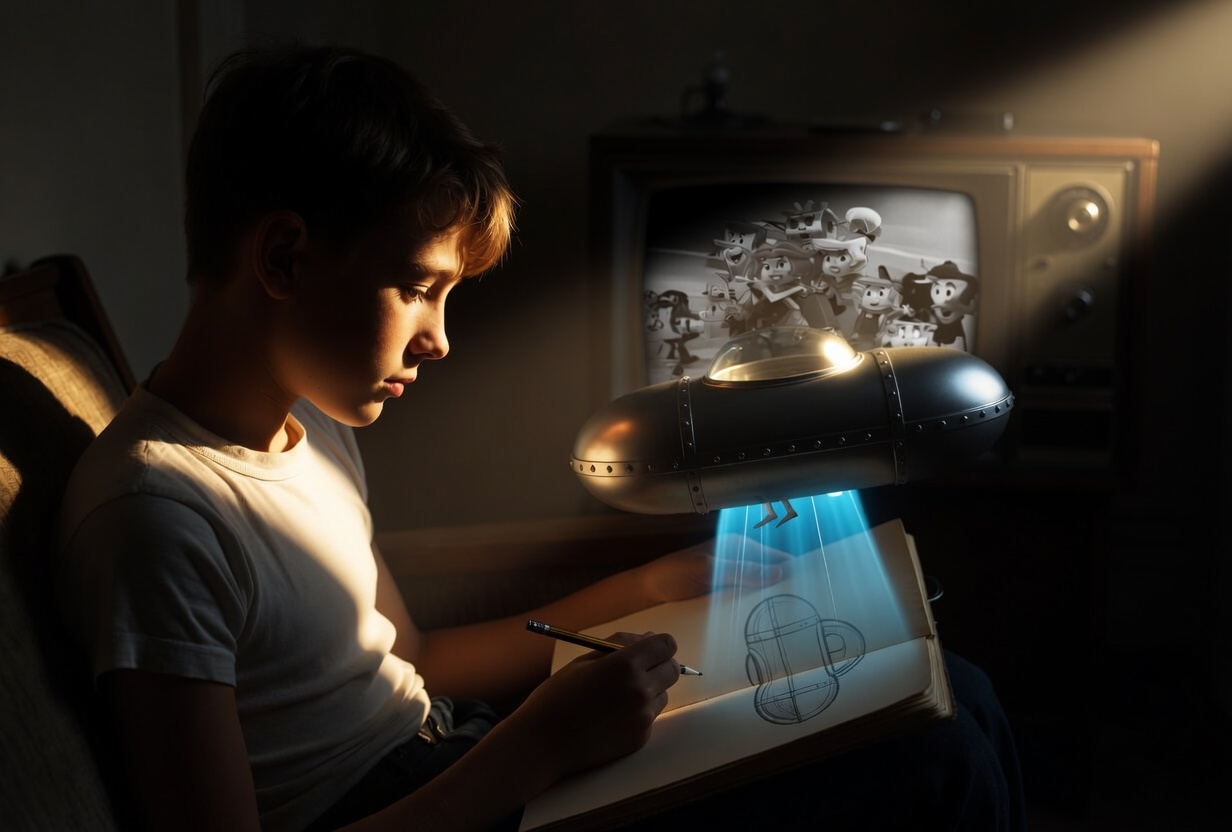
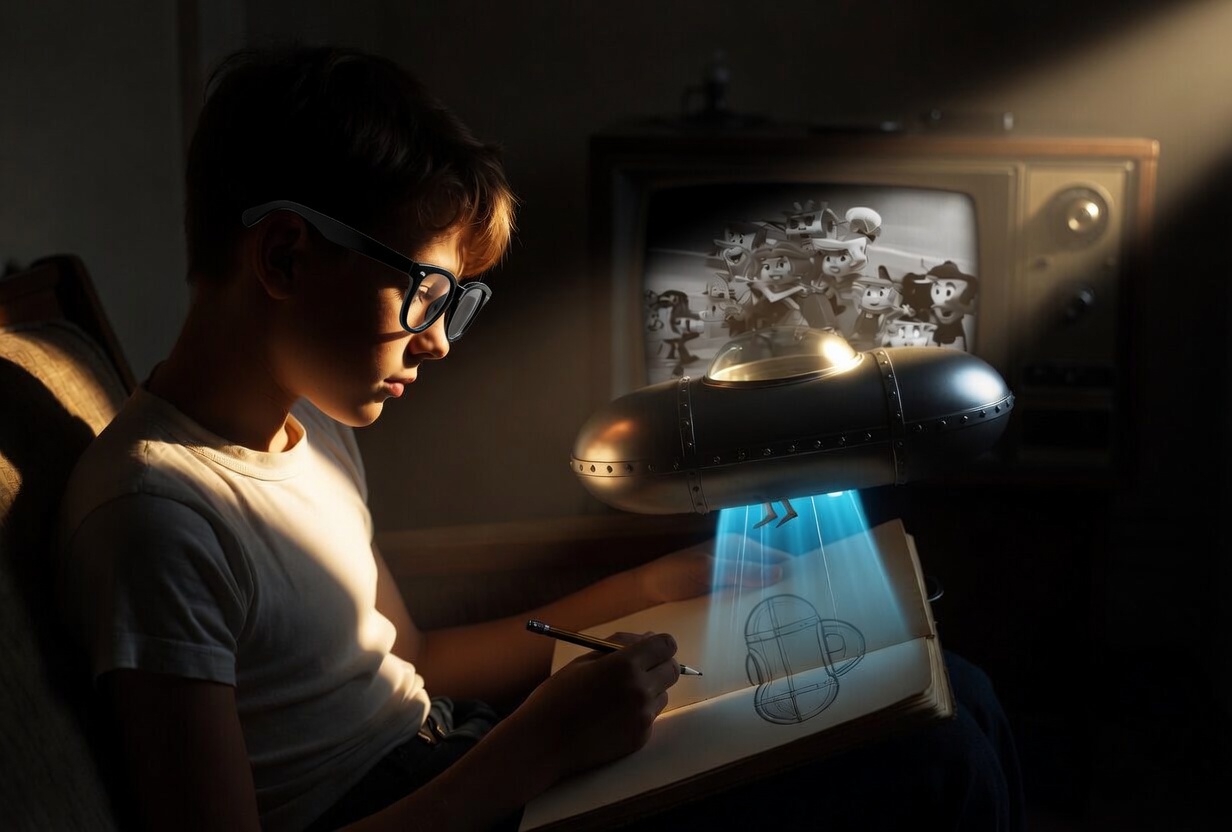
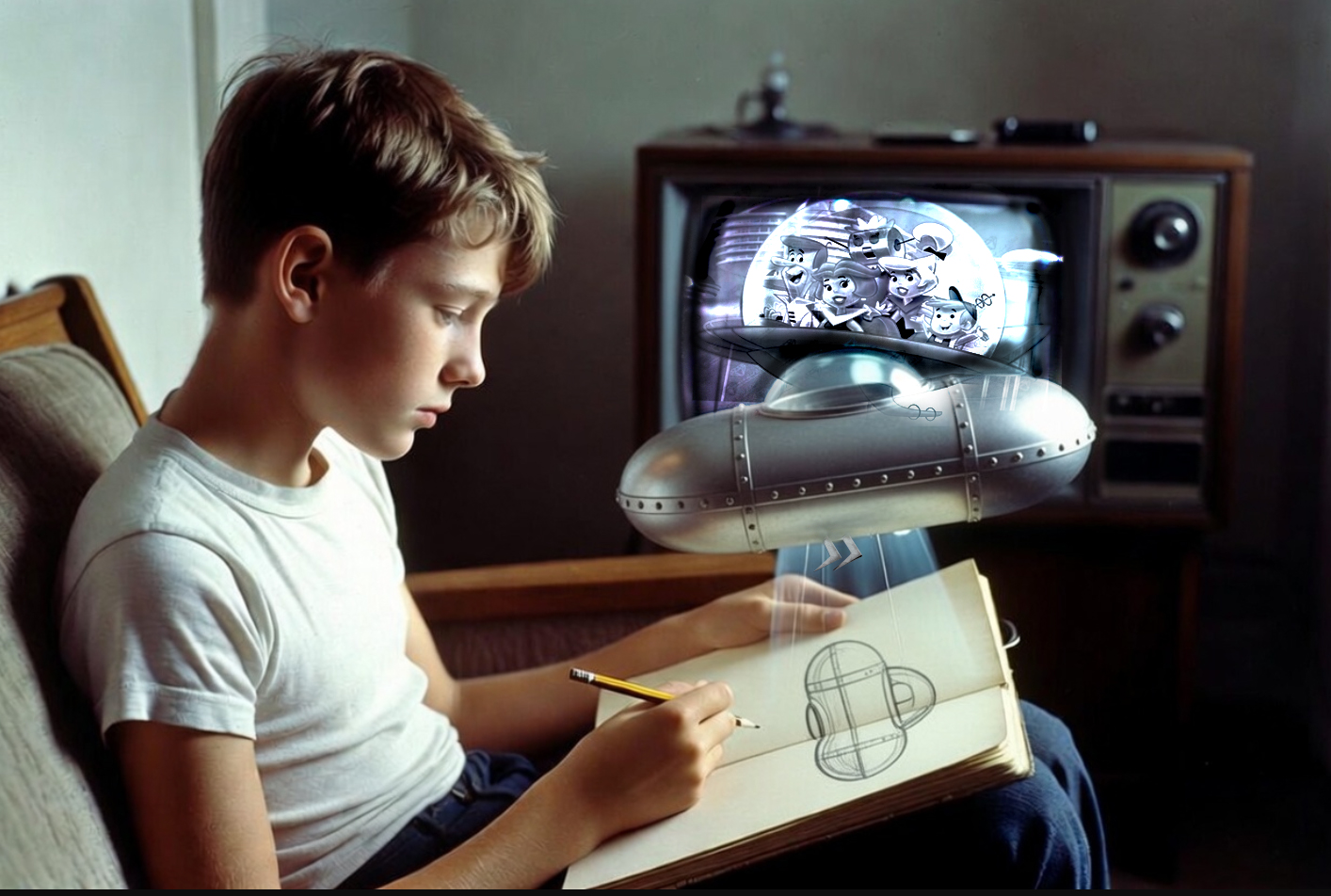
There are frauds who lie with clumsy invention, and then there are frauds who borrow something so perfectly formed that the borrowing itself becomes invisible. Bob Lazar belongs to the second and rarer category. In 1989 he stepped forward with a story so clean, so visually coherent, that intelligent people — physicists, journalists, engineers, even the occasional skeptic with a soft spot for the exotic — found themselves nodding along. Here was a man claiming to have worked on alien propulsion systems at a secret facility called S-4, near the notorious Area 51. The craft, he said, were smooth, disc-shaped, metallic, utterly without visible exhaust or intake, capable of hovering without tilt or compensation and accelerating in ways that defied every known law of inertia. They manipulated gravity itself, he explained, or rather the relationship between mass and the gravitational field. No rockets. No jets. No reaction mass. Just a localized inversion of the normal rules.
It was a compelling tale. It still is. The problem is that every single visual and functional detail Lazar described had already been drawn, inked, colored, and broadcast to millions of American children on Saturday mornings twenty-seven years earlier. But to understand how the image got onto that Saturday morning television screen in the first place, you have to go back further still. You have to go back to a private pilot named Kenneth Arnold, a mountain range in Washington State, and a reporter who made one small error that has never been fully corrected.
On the twenty-fourth of June, 1947, Kenneth Arnold was flying his CallAir A-2 near Mount Rainier when he observed a chain of nine objects moving at high speed along the Cascade range. He was an experienced pilot, a businessman who flew regularly for work, and by every available account a sober and careful observer. He reported what he saw to the authorities and then, fatally, to a reporter. What he told the reporter was precise: the objects moved, he said, like a saucer would if you skipped it across water. He was describing motion. He was reaching for the nearest available analogy to a skipping, tumbling, erratic flat trajectory — the kind of motion produced by a clay pigeon launched from a skeet trap, or a disc thrown at a low angle across a flat surface. He had watched both. He was a pilot who had spent time around airfields and ranges. The image was ready to hand.
The reporter heard shape. The reporter printed shape. The headline went out describing objects shaped like saucers, and the flying saucer was born — not from Arnold's observation, not from any physical characteristic of the objects he saw, but from a single reporter's auditory compression of a simile into a noun. Arnold never described disc-shaped craft. He described a motion and chose an analogy, and the analogy was sheared of its context and press-run into permanence before he had left the building.
Nobody asked about clay pigeons. Nobody asked whether a man who had spent years watching skeet ranges and airfields might have a well-stocked visual memory for flat, spinning, tumbling objects against a bright sky. Nobody asked whether perceptual uncertainty at altitude and distance, combined with a brain primed by exactly that kind of visual experience, might produce precisely this report. The boring explanation was available from the first hour. It was never retrieved. The interesting explanation — visitors, craft, something the authorities were hiding — was simply more satisfying, and satisfying explanations, once loose, do not wait for competitors.
What Arnold actually saw remains genuinely uncertain. The honest answer is that we do not know, and the conditions of the observation — distance, altitude, atmospheric refraction, the limitations of human visual tracking at speed — make retrospective certainty impossible. What is not uncertain is the mechanism by which his report became an icon. A simile lost its vehicle. A motion became a shape. And the shape, once named, began to attract everything the culture wanted to project onto it: secrecy, technology, the uncomfortable possibility that the official version of things was incomplete.
The Hanna-Barbera artists who sat down in 1962 to design the Jetsons' family car did not think of themselves as illustrating Kenneth Arnold's misquote. They were working from the accumulated visual culture of fifteen years of flying saucer mythology — comic books, pulp magazines, B-pictures, newspaper illustrations — all of which traced back, through a chain of borrowings and elaborations, to that one compressed headline. They drew what the culture had decided a futuristic vehicle looked like, and the culture had decided this largely because a reporter in 1947 had turned a verb into a noun. The disc was already canonical. The animators simply gave it a domestic interior, a fold-down roof, and George Jetson.
The craft Lazar claimed to have seen and worked on was, to the last curve and absence, the terminus of this chain.
Consider the grammar of the thing. The vehicle is a sealed, glassy bubble with open sides yet no apparent interaction with the air. It hovers with no downward thrust, no tilt when it accelerates, no wake, no exhaust trail, no intake vents, no rotors, no visible power plant of any kind. Its base is comically small for the load it carries — a nuclear family plus groceries — yet it remains perfectly stable. The entire form is smooth, continuous, almost organic in its refusal to acknowledge the usual engineering compromises. When it moves through the sky of Orbit City it does not fight the medium; the medium simply ceases to matter. The buildings it passes are themselves balanced on impossibly slender stalks, discs and pods suspended high above any visible foundation, as though the very concept of "ground" has been politely excused from the conversation. Friction is absent. Compensation is absent. The relationship between object and gravitational field has been quietly, elegantly inverted.
This is not a description of classified extraterrestrial hardware. It is a description of a 1962 Hanna-Barbera animation cel.
The visual grammar of the Jetsons universe is worth sitting with longer than most people have bothered to. It is easy to dismiss it as cartoon shorthand, the lazy aesthetic of a medium that could not be expected to do real physics. But that dismissal is too quick, and it misses what the artists actually accomplished. Every element of Orbit City obeys the same underlying logic. The stalks supporting the apartment towers are not structural in any engineering sense — they do not widen at the base, do not form buttresses or tension members, do not acknowledge the lever arm of wind load against a cantilevered disc. They are pins. They are the minimal expression of a single idea: that the object above has not been lifted by the stalk but has simply been anchored to a point in space by it. The stalk does not hold the building up. It holds the building here. The distinction is everything.
This is precisely the distinction that conventional engineering cannot make, because conventional engineering begins from the assumption that gravity is a one-directional transaction between the object and the field — the field pulls, the object either resists through structure or falls. The Jetsons universe draws a world in which this assumption has been set aside at the object level. The building, the car, the commuter pod zipping between skyscrapers — none of them are resisting the gravitational field. None of them are being held up against it. They have simply changed their relationship to it, the way a dial changes a radio's relationship to a frequency. The field is still there. The objects are still there. But the expected directionality of the exchange has been reversed at the object's end. They are no longer subjects of the field. They are, in some drawn and unspoken sense, its peers.
The animators did not derive this from physics papers. They derived it from aesthetics: from the desire to show a world that was clean, effortless, liberated from the visible machinery of struggle. In reaching for that aesthetic, they produced something that functions, in retrospect, as a remarkably coherent visual hypothesis about what a genuinely post-Newtonian transport technology would look like. Not anti-gravity in the old pulp sense — some reverse beam that pushes down on the sky the way a rocket pushes down on the ground — but something prior to that, something more fundamental. An alteration in how the object participates in the gravitational transaction.
The cartoon was the hypothesis. Everything that came after was footnote.
Lazar's genius, if that is the word, was to take this ready-made icon and drape it in the language of classified secrecy. He gave it a name — the "Sport Model" — and a provenance — reverse-engineered from extraterrestrial sources. He added just enough technical-sounding jargon ("gravity amplifiers," "element 115") to flatter the scientifically literate listener without ever quite submitting to falsification. And he delivered the whole performance with the calm, slightly weary affect of a man who had seen wonders and was now condemned to be disbelieved. It was a masterclass in narrative economy. He did not need to invent a new visual language; he simply repackaged one that had already been perfected for mass consumption.
It is worth dwelling on element 115, because it is the detail that most reveals the structure of the con. At the time of Lazar's claims, element 115 — moscovium, as it would eventually be named — had not been synthesized. Its existence was theoretical. By invoking it as the fuel source for the gravity amplifiers, Lazar placed his story at the precise edge of what could be checked, which is exactly where a well-constructed false claim needs to live: close enough to established science to sound plausible, far enough from confirmed fact that refutation requires equipment most people don't have. When element 115 was eventually synthesized in 2003, its confirmed existence was treated by Lazar's supporters as vindication. It was not. A theoretical element predicted to exist by the periodic table's internal logic is not the same as an exotic stable isotope capable of generating gravitational fields. But the conflation was irresistible, and Lazar allowed it to stand. He had built a claim that could absorb confirmation of its peripheral details while the central assertion remained permanently beyond reach.
This is a technique with a long pedigree. It requires, at its foundation, a compelling image — something so visually and emotionally satisfying that the audience's critical faculty is already partially suspended before the argument begins. Lazar had the image. It had been on television since 1962.
What makes the deception sting is not that it fooled the credulous. The credulous are always with us. What makes it sting is that it fooled people who should have known better — people with advanced degrees, people who pride themselves on intellectual rigor, people who can spot a logical fallacy at fifty paces. They looked at Lazar's descriptions and saw something profound: a technology that had transcended the Newtonian prison. They did not see, or did not wish to see, that they were looking at a cartoon that had simply been allowed to grow up. The smooth hull, the absent exhaust, the effortless hover, the tiny contact patch supporting an impossible load — every detail was already on file in the cultural archive, filed under "Saturday morning, 1962."
This is worth examining as a phenomenon in its own right, independent of Lazar. Why does that particular image — smooth, sealed, disc-adjacent, frictionless, weightless in affect — carry such extraordinary persuasive power? The answer has something to do with the specific historical moment in which it was crystallized. The early 1960s were a period of genuine ontological vertigo for the American scientific imagination. The atomic bomb had demonstrated that matter and energy were interchangeable. Sputnik had demonstrated that the sky was not a ceiling. The quantum mechanics that had been quietly revolutionizing physics since the 1920s was beginning to filter into popular consciousness in its most unsettling implications: that at the fundamental level, the universe did not behave the way a billiard table behaves, that certainty was a statistical artifact, that observation itself was not passive. Into this atmosphere of expanding possibility, postwar American design poured an aesthetic of effortlessness — the Googie coffee shop with its boomerang roof, the concept car with its jet-intake grille and bubble canopy, the optimistic streamline of a culture that believed, with some evidence, that it was winning its argument with the physical world.
The Jetsons car is the concentrated form of that belief. It is not merely a futuristic vehicle. It is a statement about what the future owed humanity: freedom from the indignity of mechanical struggle, from the grease and noise and compromise of internal combustion, from the whole apparatus of effort that defined terrestrial life. The smoothness of the hull is not an engineering feature. It is a moral claim. And moral claims, particularly those expressed in visual form and absorbed in childhood, are extraordinarily resistant to later revision.
Lazar understood this, consciously or not. He was not selling a physics theory. He was selling the memory of a Saturday morning and the feeling that the world might yet deliver on its early promises.
And so we arrive at the persistent reports of unidentified aerial phenomena that continue to surface in the same visual register. Smooth. Metallic or translucent. No visible propulsion. No sonic boom. Instant changes in velocity without apparent inertia. Hovering with no tilt or compensation. Frequently sighted near power installations, nuclear facilities, electrical grids — places where energy is concentrated and available. The descriptions match the Jetsons grammar with almost embarrassing fidelity. The objects do not appear to fight the air or the ground; they appear to have altered their relationship to both. They do not accelerate; they reposition. They do not thrust; they simply occupy a different place in the field.
The frequency with which these sightings occur in the vicinity of power infrastructure deserves more careful attention than it typically receives. The standard interpretation — that the objects are surveilling military or energy installations for strategic intelligence purposes — assumes an observer operating from an external vantage point, a visitor conducting reconnaissance. But reconnaissance does not require proximity to power sources. Observation can be conducted from altitude, from distance, from the darkness on the other side of a radar horizon. The persistent clustering of sightings around power grids and nuclear installations suggests something different: that the objects are not observing the energy so much as using it, and that their use of it is not storage or extraction in any conventional sense, but something more like borrowing the gradient.
This distinction — between extracting energy and borrowing a gradient — matters enormously. An object that has inverted its relationship to the gravitational field is not, by hypothesis, drawing power from the field in the way a turbine draws power from moving water. It is adjusting its position within a transaction. And adjusting a position within a transaction requires a reference point — a stable, high-energy anchor against which the adjustment can be defined and maintained. Power stations, reactor facilities, transmission grids: these are not fuel. They are coordinate systems. They are the places where the energy landscape of the local environment is steep, defined, and reliably present. An object maintaining an unusual relationship with the gravitational field might require exactly this: not fuel, but a reliable topography against which to hold its position in the field.
One is tempted, in the face of such consistency, to reach for the comforting extraterrestrial explanation. Little green men. Reverse-engineered alien craft. Ancient visitors. The intelligence community itself has flirted with these possibilities, releasing videos and admitting that some sightings remain unexplained. Yet the more parsimonious hypothesis — and the one that requires no conspiracy, no vast black-budget hangar, no interstellar visitors — is that these phenomena are information moving through time, briefly stabilizing itself in our local reference frame by borrowing the energy gradient it finds nearest at hand. Power stations, grids, military installations: these are not refueling stops. They are anchor points. The objects are not "flying" in any conventional sense. They are adjusting their participation in the gravitational transaction so that the information they carry can remain coherent across temporal displacement.
This is, of course, only a hypothesis. It does not claim to be proven. It merely observes that the visual grammar has remained strangely stable for more than sixty years, that the objects consistently appear where abundant power is available, and that the simplest explanation for both facts may not involve little green men at all. It may involve a form of temporal information transfer that our pattern-matching minds, primed by a 1962 cartoon, insist on interpreting as exotic propulsion.
It is also worth noting what Lazar did not do, because the omissions are as revealing as the claims. He did not attempt to explain the mathematics of gravitational inversion. He did not sketch a mechanism, propose an energy budget, describe the internal geometry of the gravity amplifiers in any detail that would permit even a theoretical evaluation. He offered, instead, impressions: the smooth interior, the absence of seams, the organic quality of the materials, the sense of wrongness that a human body felt in proximity to the operating craft. These are the descriptions of a man reporting an aesthetic experience, not a technical one. They are, in other words, exactly the descriptions you would expect from someone who had absorbed a powerful visual image and was now reconstructing it from the inside — reporting the feeling of the thing rather than its mechanism, because the feeling was all he had.
A man who had genuinely worked on reverse-engineered propulsion systems would have been haunted by the engineering problems. He would have fixated on the questions that couldn't be answered, the tolerances that didn't make sense, the materials that behaved in ways inconsistent with known physics. These are the things that stay with engineers. Instead, Lazar gave us atmospherics. He gave us the smoothness of the hull, the color of the walls, the strange quality of the light inside the craft. He gave us, in short, the things a person notices when they look at an image and let it work on them. The things a child notices on a Saturday morning, lying on a carpeted floor with a bowl of cereal, watching a cartoon car lift silently into a clean blue sky.
The story has acquired, in recent years, a new chapter — one that illustrates with almost clinical precision how the machinery of belief perpetuates itself once it has been set in motion. An independent researcher, working from publicly available aerial photography taken by a private pilot who overflew the Papoose Lake area during the pandemic, claims to have located the hangar doors of S-4 itself. The evidence, such as it is, consists of contrast-enhanced images showing geometric lines on the face of a mountain — straight edges, angled recesses, shadows suggesting depth. Bob Lazar has looked at these images and confirmed them. The filmmaker who spent years building a three-dimensional reconstruction of S-4 from Lazar's testimony has confirmed them. They have been discussed on podcasts with millions of listeners. The revelation is apparently imminent. The brain-melting evidence dump is perpetually forty-eight hours away.
None of this requires alien spacecraft to be embarrassing. It requires only a basic familiarity with industrial mining infrastructure.
The Papoose Mountain range was silver mining country. The geometry being identified in these photographs — slanted rectangular openings of varying widths, straight horizontal lines across a mountain face, shadow recesses indicating depth behind the surface — is the standard visual signature of a multi-bay ore loading facility. Specifically, it matches the profile of a trapezoidal sliding gate set into a rectangular frame: wider at the top than the bottom, producing angled sides, a clean horizontal line at the head, and a shadow recess that reads, in a contrast-enhanced aerial photograph taken at distance, exactly like a hangar door with something hidden behind it. The first opening being slightly wider than the others — which the researcher flags as confirmation that it is the large hangar, the primary bay — is equally consistent with a standard multi-bay loading configuration in which the primary bay is sized for larger haul trucks.
The geometry is mining geometry. It was put there by miners. It has been there, in all likelihood, since before Bob Lazar was born. Which is precisely the point. Because Bob Lazar already knew exactly what a mine looked like.
The researcher has spent three years proving that a mine exists. He is preparing to present this as proof of spacecraft.
A working ore facility requires roads capable of handling loaded haul trucks. It requires drainage. It requires power supply. It requires personnel access. At the throughput rates consistent with a silver mining operation — even a modest one, say five hundred to fifteen hundred tonnes per day — it generates visible infrastructure: tire tracks calibratable against known vehicle widths, road wear patterns consistent with regular heavy traffic, berm structures managing runoff from the loading area. All of this is independently observable and independently verifiable. None of it requires a government conspiracy to explain. None of it requires the confirmation of a man with reasons to agree.
What makes this episode instructive is not the researcher's error, which is forgivable — aerial photography of desert terrain is genuinely difficult to read, and the human pattern-matching faculty is exquisitely sensitive to geometric regularity precisely because geometry in nature is rare. What makes it instructive is the confirmatory structure that immediately assembled itself around the images. Lazar confirmed them because they match his memory, which is the weakest possible form of corroboration — a man being shown an image and agreeing that it resembles what he claims to have seen tells you nothing about the image and a great deal about the malleability of visual memory. The filmmaker confirmed them because they match his Blender reconstruction, which was itself built entirely from Lazar's testimony. The podcaster confirmed them because they were confirmed by the others. Each node in the network is pointing to the others as its source. The structure is a closed loop dressed as a chain of evidence.
Lazar grew up in Westbury, Long Island, a town defined in the postwar decades by some of the largest sand mining operations in the country — massive industrial pits, heavy excavation machinery, the full vocabulary of large-scale extraction embedded in the landscape of his childhood. He did not need to observe a classified facility in the Nevada desert to know what a mine entrance looked like, what the geometry of a hillside installation felt like, what the doors and shadows and recessed openings of an industrial excavation site presented to someone standing outside them. He had grown up inside that visual grammar. His father, Albert Martin Lazar, served in the Air Force, which supplied the second half of the construction kit: the security cameras, the checkpoints, the particular bureaucratic atmosphere of installations that do not officially exist, the whole texture of a place where cleared personnel move through doors that are not on any public map. When Lazar needed a cover story for how a secret facility might hide itself inside a desert mountain, he did not invent. He remembered. He reached into the two most formative visual environments of his childhood — his father's world and his backyard — and assembled from them something that felt, to everyone who heard it, uncannily lived-in. It felt lived-in because it was. The mine was real. It was just on Long Island.
There is a further irony buried in all of this, and it is perhaps the most instructive one. The Jetsons was a sitcom about George Jetson, a man who complained about his boss, argued with his wife, and worried about money. His relationship with his flying car was precisely as unreflective as the average commuter's relationship with his sedan. He didn't know how it worked. He didn't need to. It worked, and that was enough. The technology had become so fully domesticated that it had ceased to be interesting as technology. It was furniture.
This domestication is, in its way, the most radical thing about the Jetsons universe. It is not a world in awe of its own achievement. It is a world that has moved on. The inversion of the gravitational relationship — if that is what the artists drew — has been fully absorbed into the texture of ordinary life, as unremarkable as the wheel or the lever. Nobody in Orbit City stops to marvel at the fact that their buildings float. The buildings float because buildings float; that is what buildings do. The technology's revolutionary origin has been forgotten in its own success.
This is, historically, what genuinely transformative technologies tend to do. The electromagnetic principles underlying the electric motor were, at the moment of their discovery, among the most mind-altering insights human beings had ever produced. Today the electric motor is in a billion toothbrushes, and nobody thinks about Maxwell. The compression-ignition cycle that powers the diesel engine represents a fairly extraordinary insight into thermodynamics. It moves freight across continents and nobody aboard the truck reflects on Rudolf Diesel. Transformation, once fully absorbed, becomes invisible. The Jetsons were drawing a world in which the next transformation had been absorbed so completely that it had become toothbrush-level mundane. The flying car was the mundane form of the revolution.
Lazar put the mystery back. He took the mundane symbol and reverse-engineered its strangeness, repackaged the toothbrush as sacred artifact. He gave back to the image the aura of the inexplicable that the Jetsons had stripped away by domesticating it. And because the image was so potent, so deep in the cultural memory, so tied to that specific historical feeling of expanding possibility, the audience was ready to receive it as revelation.
How powerful a visual grammar can be is not a question that gets asked seriously enough in the literature on deception and belief. The standard account of how false beliefs propagate focuses on argument — on logical fallacies, on motivated reasoning, on the structure of confirmation bias. These are real and important. But they operate downstream of image. Before the argument, there is the picture. Before the claim, there is the form. The form generates a feeling, and the feeling generates permission — permission to find the argument persuasive, to excuse its gaps, to accept its silences as classified rather than empty.
Lazar's image was already in place before he opened his mouth. It had been in place for twenty-seven years. He walked into an interview with George Knapp in 1989 and described a vehicle, and the people listening did not have to construct its form from his words — they already had it, already felt it, already half-believed in it, because they had grown up with it flickering at them from a television set on Saturday mornings. He was not asking them to imagine something new. He was asking them to remember something familiar and accept that the familiar thing was real.
That is the most efficient form of persuasion available. It requires no invention, only recognition. And recognition, unlike argument, bypasses the critical faculty almost entirely, because the critical faculty monitors for the unfamiliar. It is the unfamiliar that triggers scrutiny. The familiar slides through.
And here is the neutron bomb at the center of the whole affair, the thing that vaporizes the pretense while leaving the architecture standing: the selective skeptic — the one who leads with dissolution, who reaches instinctively for the most corrosive possible reading of received wisdom — is not protected from this mechanism. He is more vulnerable to it. His skepticism has been deployed so aggressively in one direction that the other direction stands effectively unguarded. He has torched the received. He has torched the institutional. He has torched the comfortable consensus. And in the smoking clearing that remains, something smooth and sealed and visually coherent lands without a sound, and he looks at it with fresh, undefended eyes, and he feels the click of recognition, and he calls it evidence. He does not recognize it. He has forgotten — or never knew — where he first saw it. The man who will not accept a resurrection has no difficulty accepting a flying saucer, provided the flying saucer arrives wrapped in the grammar of official suppression. The credulity was never gone. It was only redirected. And redirected credulity, unlike the original kind, comes armored with the self-image of the person who has already done the hard work of doubting. It is nearly impervious to correction. You cannot tell a man he is being credulous when he has already demonstrated, to his own satisfaction, that he is not the credulous type.
This is the quiet, enduring fraud at the heart of the Lazar legend. Not the man himself, who was merely an opportunist with an eye for cultural readymades. The real deception lies in our collective refusal to admit how much of what we call the unknown is simply the familiar wearing a new coat of mystery. The flying car never left the page. We just forgot where we first saw it.
And in forgetting, we made ourselves available to be sold our own childhood back to us as classified information — at a premium, with a government conspiracy attached, and with just enough element 115 sprinkled over the whole affair to make us feel that our credulity was actually a form of scientific open-mindedness.
The cartoon was never the deception. Its coherence was the weapon, and Lazar simply picked it up.
Perhaps the most honest thing one can say about the entire episode — Lazar, the UAP reports, the sixty-year persistence of the same visual grammar in sighting after sighting — is that the image itself is doing the real work, and has been doing it all along. We live inside a set of pictures we absorbed before we had the vocabulary to question them. Those pictures tell us what the future looks like, what the impossible looks like, what a technology that has moved beyond our own would look like. And when something appears that matches those pictures closely enough, we do not ask whether the picture is evidence or template. We do not ask whether we are seeing something real or recognizing something remembered. We simply feel the click of recognition, and in that click — warm, certain, childhood-bright — we surrender the better part of our judgment.
While the debate about Lazar has continued — the podcasts, the Instagram researchers, the contrast-enhanced photographs, the perpetually imminent evidence dumps — the United States government has quietly built a legal framework around the very thing being debated. Between 2024 and 2026, statutory language inserted into National Defense Authorization Acts created formal categories for Technologies of Unknown Origin and Non-Human Intelligence. The Pentagon maintains publicly that no verifiable extraterrestrial technology exists. The legislature has simultaneously constructed the machinery to handle it. These positions are not compatible, and governments do not build legal frameworks for phenomena they have concluded do not exist. The more consequential development is what this framework is actually being used for: not to confirm flying saucers, but to claw back exotic materials that were transferred to private aerospace contractors decades ago and have since been claimed as proprietary intellectual property. The government is not asking whether there is life on other planets. It is asking who owns the patent on the gravity drive.
The cartoon was always the more interesting object. Not because it contained a hidden blueprint, not because the Hanna-Barbera artists were in possession of classified knowledge, but because it managed, through the ordinary pressure of aesthetic ambition, to encode a genuinely coherent physical intuition in a form that millions of people absorbed at the age when absorption is deepest. Whether any technology will ever make that intuition real — whether the inversion of the gravitational transaction is a thing that can actually be done, and not merely a thing that can be drawn — remains an open question. But the drawing came first. And it is the drawing, not the testimony, not the grainy video, not the congressional hearing, that has done the most to shape what we think we are looking for when we look at the sky.