Sodom on the Platte
Colorado's cannabis haze and the last stand of Kaley Chiles
In the shadow of the Rockies, where the South Platte River slithers through Denver's concrete veins, a new Sodom rises—not with the brazen lust of Genesis, but with a subtler, more insidious sin: a haze of cannabis that cloaks the soul of a civilization. Colorado, once a bastion of pioneer grit, has traded its birthright for a $2.2 billion bong hit, peddling dependency in the name of liberty, and now stands on the precipice of divine judgment.
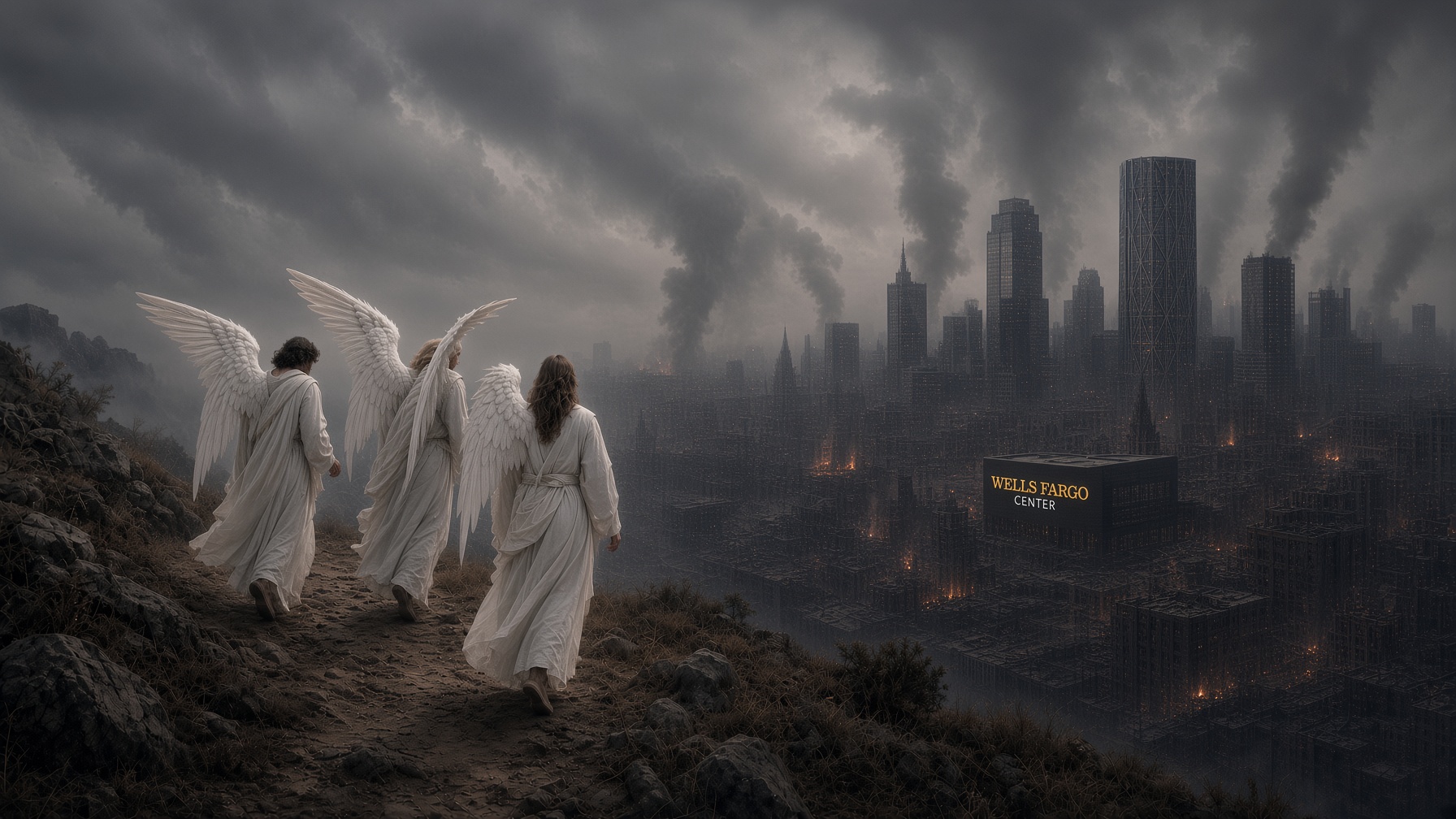
At its gate, Kaley Chiles, a counselor cast as Lot in this modern morality play, risks all to shield the innocent—children, angelic in their confusion, seeking her guidance against a ravenous culture. Yet, as the Supreme Court weighed her fate in Chiles v. Salazar , the question loomed: could she save these angels, or would Colorado's pride, gluttony, and apathy invite the brimstone it so richly deserves?
“Colorado, once a bastion of pioneer grit, has traded its birthright for a $2.2 billion bong hit.”
Ledger of the Modern Sodom
A dependency dressed in dollar signs
Let us not mince words. Colorado's cannabis economy is no triumph of progress but a page torn from the Opium Wars' playbook—a deliberate softening of a people, not by gunboats but by green profit. Since Amendment 64 unleashed recreational weed in 2014, the state has reaped $3 billion in taxes, a pittance against its $50 billion budget, yet sold its soul for a mere 0.8% fiscal bump.
The cost? A staggering $1.5 billion annually in wreckage—emergency rooms choked with psychosis cases, traffic deaths spiked 138% by THC-addled drivers, and a workforce dulled by 18% of adults toking monthly, up from 13% pre-legalization. The dispensaries, those sterile shrines to escapism, are less markets of sophistication than fluorescent vending machines, doling out 90% THC dabs in child-proof foil like dystopian candy stores.
Out in the fields, 70% of the labor—often undocumented, paid $15 an hour to breathe pesticide fumes—props up this mirage, exploited in conditions that would shame a Dickensian sweatshop. This is not freedom; it is dependency dressed in dollar signs, a slow bleed of vitality that echoes the opium dens that humbled China.
“Less markets of sophistication than fluorescent vending machines, doling out 90% THC dabs in child-proof foil.”
A shrine to escapism: the counter, glowing after hours
The Price of the High
Pride, excess, apathy, injustice—and a counselor at the gate
And what of Ezekiel's indictment, that ancient ledger of Sodom's sins? Pride, excess, apathy, injustice, and perversion—these are no mere biblical relics but the very pulse of Denver's decay. Pride struts in the city's self-congratulatory liberalism, bidding for the 2030 Gay Games while its homeless swell 10% amid untaxed tent cities. Excess festers in the gluttony of cannabis, a culture chasing highs over meaning, with suicide toxicology reports doubling to 29% THC-positive. Apathy turns a blind eye to the poor, as $30 million in weed taxes fails to dent a $200 million housing crisis. Injustice reigns in the fields, where illegal migrant workers toil in debt traps, and in the courts, where Chiles v. Salazar threatened to silence counselors who dare defy the affirmation-only dogma. And perversion? Not the crude caricature of Genesis 19's mob, but a subtler one: a state mandating that every child questioning their identity be funneled toward transition, no dissent allowed, no faith permitted.
Enter Kaley Chiles, our Lot, standing resolute at the gate. A Christian counselor, she dares to offer sanctuary to children—those angelic souls wrestling with gender dysphoria or same-sex attraction—who seek not affirmation but alignment with the Western values that forged civilization: order, purpose, the sanctity of the created self. These are not broken children but seekers, asking to explore paths rooted in faith or biology, free from the ravenous monsters of a culture that demands conformity.
Colorado's Minor Conversion Therapy Law, upheld by the state and defended all the way to the Supreme Court, branded her work as harm, threatening her license for daring to speak against the tide. Like Lot, who pleaded with Sodom's mob to spare his guests, Chiles risked her livelihood to protect these angels from a system that would rather drug them into submission—be it with cannabis or ideology—than let them question the script.
The monsters are legion. They are the regulators who wield fines and suspensions to silence dissent. They are the profiteers of a cannabis industry that numbs a generation while exploiting its laborers. They are the cultural architects who, under the banner of progress, erase the Judeo-Christian bedrock—individual dignity, family, truth—that built the West.
Chiles, like Lot, is tormented by this lawlessness, her conscience stirred not by a burning bush but by a conviction that echoes Ezekiel's warning: a society that revels in pride, gluttony, and injustice invites its own ruin. Her stand is a clarion call, a plea to turn back before the sulfur falls.
The Angels Walk Out of the City
When we first published this piece, we asked whether Chiles could save Colorado. We now have an answer—or at least the first half of one.
On March 31, 2026, the Supreme Court handed down Chiles v. Salazar , and the verdict was not close. Eight to one. Justice Gorsuch, writing for a majority that stretched from Thomas to Sotomayor, held that Colorado's law, as applied to a counselor who does nothing but talk with willing clients, regulates speech on the basis of viewpoint—the most disfavored thing a government can do under the First Amendment. The Tenth Circuit, which had waved the statute through under the flimsiest rational-basis review, was reversed and sent back to apply strict scrutiny, the standard under which viewpoint-based speech restrictions almost never survive. Colorado may still shuffle back to court and try to prove its ban is narrowly tailored to a compelling interest. Good luck. The mob at Lot's door has been struck blind, and it is now fumbling for the handle.
Note what the majority did not do. It did not declare open season on minors, did not license any quack with a diploma to do as he pleases, did not touch the actual practice of medicine. It held something so elementary that eight justices of wildly divergent philosophy could agree on it: a state may not tell a licensed professional that she may help a child walk in one direction but never in the other. Colorado's statute permitted counselors to assist “identity exploration” and “gender transition” while forbidding any effort in the opposite direction. That is not a treatment standard. That is a thumb on the scale, and the Court called it what it was.
Even Justice Kagan—no friend of this magazine's worldview—could not stomach the state's position. Her concurrence, joined by Sotomayor, said the quiet part plainly: when a state suppresses one side of a debate while subsidizing the other, the constitutional question answers itself. She left the door open to a viewpoint-neutral regulation, which is fair enough; the Constitution has never barred Colorado from insisting on competence. It bars Colorado from insisting on orthodoxy.
Outside the Court, March 31
The 8-to-1 Majority
The Dissent That Ate Itself
Justice Ketanji Brown Jackson, alone, dissenting for thirty-five pages—longer, by the tally of court-watchers, than the majority and concurrence combined—and reading it aloud from the bench, the judicial equivalent of a jeremiad delivered to an empty pew. Her own liberal colleagues had abandoned her. Sotomayor and Kagan, who have signed every dissent worth signing in the modern era, looked at the argument she was making and quietly stepped away from it.
What was that argument? Stripped of its length, it amounts to this: Chiles was not speaking “in the ether”; she was a licensed professional, and professional medical speech, in the dissent's telling, does not belong in the marketplace of ideas at all. “Treatment standards exist in America,” the dissent announced, as though the majority had proposed to abolish medicine rather than to stop Colorado from abolishing one half of a conversation.
Consider the strangeness of that position. The dissent's theory would let any state licensing board, on any subject, convert speech into “conduct” simply by regulating the speaker's credentials. A nutritionist who doubts the state's dietary guidelines, a psychologist skeptical of the latest fashionable diagnosis, a physician who counsels caution about a new intervention—all of them, under this reasoning, are practicing conduct, not speaking, and may be silenced by the same bureaucracy that issues their licenses. This is not a narrow view of the First Amendment. It is a hole in it, shaped precisely like the professional class.
And it is no local heresy. The relabeling of speech as conduct is the oldest trick in the censor's book and the favorite of every government that has ever wished to punish an idea without admitting it. Words become “harm.” Disagreement becomes “misinformation.” A counselor's conversation becomes “treatment,” and treatment, of course, may be regulated. Once the trick is accepted, there is no dissent it cannot reach, because there is no speech that cannot be described as doing something.
Americans are fortunate: a written Constitution and eight justices stood between Kaley Chiles and that trick. Most of the world's good people enjoy no such wall. In Britain, in Canada, across much of Europe, the same theory is not a lone dissent but settled law—professionals disciplined, pastors fined, ordinary citizens visited by police over social media posts, all for speech recast as conduct by a state that answers to no First Amendment. That is the scourge the dissent would have imported, in the name of science, into the one country built to resist it. That eight justices refused is cause for gratitude. That one did not is cause for vigilance.
“There is no speech that cannot be described as doing something.”
A nervous chaperone at the dance
The dissent's tone, too, deserves a moment. It fretted that the ruling would “open a can of worms.” It confessed, with disarming candor, that “no one knows what will happen now.” One appreciates the honesty. But a Supreme Court dissent is supposed to explain why the majority is wrong, not to stand at the edge of the ruling like a nervous chaperone at a dance, wringing its hands about what the children might do next. Sodom's citizens, too, no doubt warned that letting the angels leave would open a can of worms. The angels left anyway.
What the dissent could not do—what thirty-five pages could not accomplish—was persuade a single other justice, including two who share every one of its political commitments. That is not a badge of principled isolation. It is the sound of an argument that does not work.
The lone dissent, in the mythology of the left, is Harlan in Plessy , the prophet unheeded. But Harlan was outvoted by men who agreed with each other. Jackson was outvoted by everyone, including her friends. The lesson is not that the Court has lurched rightward; Kagan and Sotomayor did not lurch anywhere. The lesson is that the state's case was so thin that even the justices most inclined to accept it could not, and only one was willing to pretend otherwise.
“That is not a badge of principled isolation. It is the sound of an argument that does not work.”
What Comes After the Fire
Lot fled Sodom with his daughters, and the city burned behind him. Chiles's fate is happier: she walks out of the courtroom with her license intact and a precedent that some two dozen other states with similar statutes will now have to reckon with. Roughly half the country had built the same wall Colorado built. The Court has told them the wall is unconstitutional as applied to talk, and it is hard to see what else a talk therapist does.
But brimstone is not a policy, and a court ruling is not a revival. Colorado's cannabis economy grinds on, its $1.5 billion in annual wreckage untouched by anything the Supreme Court said in March. The dispensaries still glow. The fields still run on borrowed labor. The tent cities still spread along the Platte while the city fathers plan their games. Chiles was never about weed; it was about whether a state that had already numbed its adults could also script its children. On that narrower question, the answer came back with the force of a near-unanimous Court: no.
Colorado stands at the abyss still, its river gleaming under a sky heavy with judgment. But for the first time in this long morality play, the angels have made it past the gate. The city has been warned. What it does with the warning—whether it repents of its haze or merely finds a new way to sell it—remains, as the dissent so helpfully observed, unknown. The clock still ticks. It just ticks somewhat less ominously now.
“The city has been warned. What it does with the warning—whether it repents of its haze or merely finds a new way to sell it—remains unknown.”