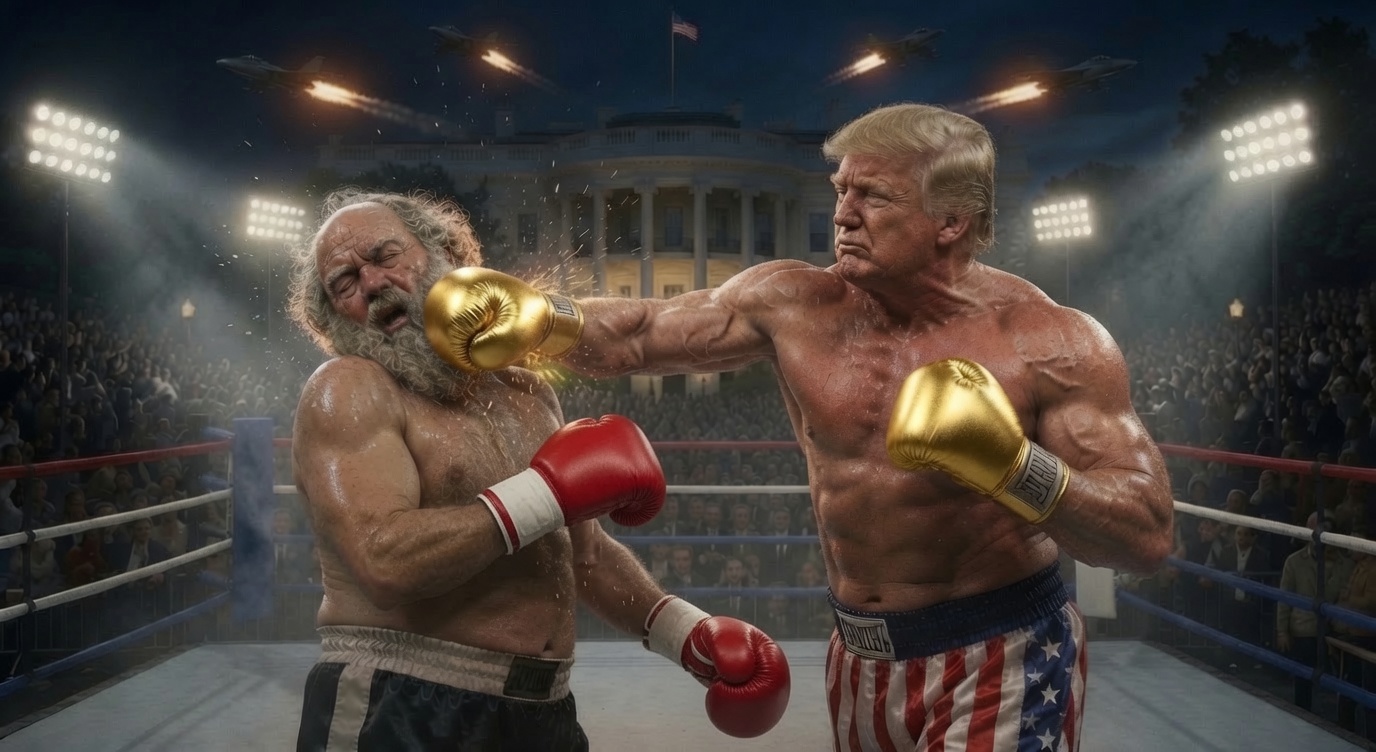
Epic Fury
While the press tries to revive the necrotic scripts of the Iraq era, the reality of the mission reveals a nation finally accepting its primacy. With a ruthlessly low casualty count and a refusal to seek permission from the faculty lounge, America has rediscovered that power is not a sin to be atoned for, but a fact to be used.
There was a moment, not long ago, when the United States remembered what it is. It did not ask permission. It did not convene panels. It did not agonize over whether its actions would look “proportional” to the editorial board of The New York Times. It simply acted, with speed, with overwhelming force, and with a cold recognition that power is not a sin to be atoned for but a fact to be used. That moment was called Operation Epic Fury, and it has already been memory-holed by people who prefer their history sanitized and their country smaller.
Thirteen Americans are dead. Three hundred and sixty-five are wounded. Those numbers are not abstractions; they are the irreducible price of sending men into harm’s way. Yet set against the ledger of recent American wars, they are astonishingly low. Compare them to the four thousand four hundred and thirty-one killed in Iraq, the two thousand four hundred in Afghanistan, the two hundred and ninety-two in Desert Storm, the fifty-eight thousand in Vietnam. The difference is not luck. It is not the mystical intercession of some higher power. It is the difference between a nation that accepts its own primacy and one that flinches from it.
The Ledger of Power: US Casualty Comparison
The press, of course, has spent the past six weeks pretending otherwise. They have dusted off the same necrotic script they have used since the invasion of Iraq: every casualty is proof of recklessness, every successful strike is treated as a moral outrage, every piece of equipment that requires repair is evidence of systemic failure. The Ford fire became, in their telling, a metaphor for imperial overreach rather than what it actually was—a laundry-room blaze on a ship that was fixed, returned to sea, and put back to work. The single F-15E shoot-down, with both pilots recovered alive, was inflated into a parable of vulnerability. The drone swarms that never materialized were invoked as though they had. This is not journalism. It is ritualized self-flagellation dressed up as analysis.
The template was perfected during the long degeneration of the Iraq War, when a generation of reporters and editors—many of them former campus radicals who had traded tie-dye for press passes—discovered they could do real damage from inside the institutions they once claimed to despise. They had entered the machine, and they had learned how to make it grind in their preferred direction. By the time Obama took office, the pattern was locked in: America must never be allowed to act like what it is—the paramount power on earth. Every use of that power must be accompanied by ritual apology, multilateral fig leaves, and earnest editorials about “the limits of American force.” The result was Libya, a country reduced to warring militias and slave markets after a half-hearted “lead from behind” campaign, and Syria, where Obama’s famous “red line” dissolved into vapor while the region burned.
It was in that same Syrian theater that Vladimir Putin, of all people, tried to lecture America on restraint. In a 2013 New York Times op-ed, he warned Obama against crossing an imaginary line that would unleash chaos and set dangerous precedents. He was half right. Unilateral American action without clear purpose does breed monsters; we have the receipts from the Arab Spring onward. But Putin was also spectacularly wrong, and the wrongness is instructive. He imagined a world in which great powers politely debate “international law” as equals. He forgot, or chose not to remember, that the reason Russia does not maintain bases on every continent is that it cannot. America can, and does. That is not a moral failing. It is a fact of power. Putin’s complaint was the whine of a man who understands the rules of the game perfectly well when they favor him, and suddenly discovers principle when they do not.
Velocity Over Bureaucracy
The genius of Epic Fury is that it refused to play the apology game. It did not pretend that American power needs to be laundered through the United Nations or the good opinion of European salons. It moved with speed and overwhelming violence against a regime that had spent years building missiles, drones, and proxy armies pointed at American interests and American allies. It destroyed launch infrastructure before the swarms could take off. It repaired its own damaged equipment in the field instead of folding. It kept the body count ruthlessly low by design, not by accident. Thirteen dead is thirteen too many, but it is not four thousand. It is not fifty-eight thousand. It is the cost of acting like a superpower instead of a nervous graduate student hoping for a good participation grade from The Guardian.
The corporate press hates this. It hates it because it exposes the hollowness of their preferred narrative—that American power is inherently suspect and that restraint is always the higher virtue. They cannot forgive an administration that declined to perform the familiar ritual of self-doubt. So they reach for the old formulas: every strike is “escalation,” every success is “destabilizing,” every dead American is proof that the whole enterprise was madness. They do this because they have spent two decades convincing themselves that the highest form of patriotism is to treat their own country as the permanent problem in world affairs. It is a form of moral onanism that feels profound in the faculty lounge and looks grotesque on the page.
Putin understood something essential in that 2013 op-ed, even if he cloaked it in cant. He saw that America’s reluctance to use its power decisively had created a vacuum that lesser actors were happy to fill. He simply preferred that vacuum to remain unfilled by anyone except himself. The current operation has closed part of that vacuum. It has reminded the world that American primacy is not a historical accident to be apologized for; it is a structural reality that can be used for good or for ill, but it cannot be wished away. The men who rebuilt Little Birds under fire, who kept momentum when mechanical failure would once have aborted an entire mission, who struck hard and then consolidated rather than dithered, understood this in their bones.
The Vacuum Index: Projection vs. Retreat
This is not triumphalism. It is realism. A nation that possesses the capacity to project power across oceans has a duty to use that capacity with intelligence and without self-loathing. The alternative is not moral purity. The alternative is the slow erosion of the very order that allows weak states to lecture strong ones. We have seen that erosion in Libya’s ruins, in Syria’s killing fields, in the refugee tides that washed up on European shores after a decade of hesitant half-measures. Epic Fury is a reminder that America can still choose otherwise.
The press will continue to run its template. It will continue to treat every American success as a moral failure and every American casualty as proof that power itself is the original sin. That is what the apparatus built during the long degeneration of Iraq has been designed to do. But the numbers do not lie. Thirteen dead versus four thousand. A war measured in weeks versus wars measured in decades. Equipment repaired and returned to the fight instead of abandoned in the desert. These are not accidents of fortune. They are the measurable difference between a country that accepts what it is and one that spends its treasure and its young men pretending it is something smaller and safer and more pleasing to the faculty lounge.
America is not just another nation. It is the paramount power of the age, whether its intellectuals like it or not. The only question that matters is whether it will use that power with the clarity and ruthlessness it demands, or whether it will continue the long, exhausting apology tour that has cost so much blood and treasure for so little gain. Epic Fury suggests the apology tour may finally be ending. The press will hate that ending, because it leaves them without their favorite role: the conscience of a nation they no longer believe deserves one.